By Ajit Krishna Dasa
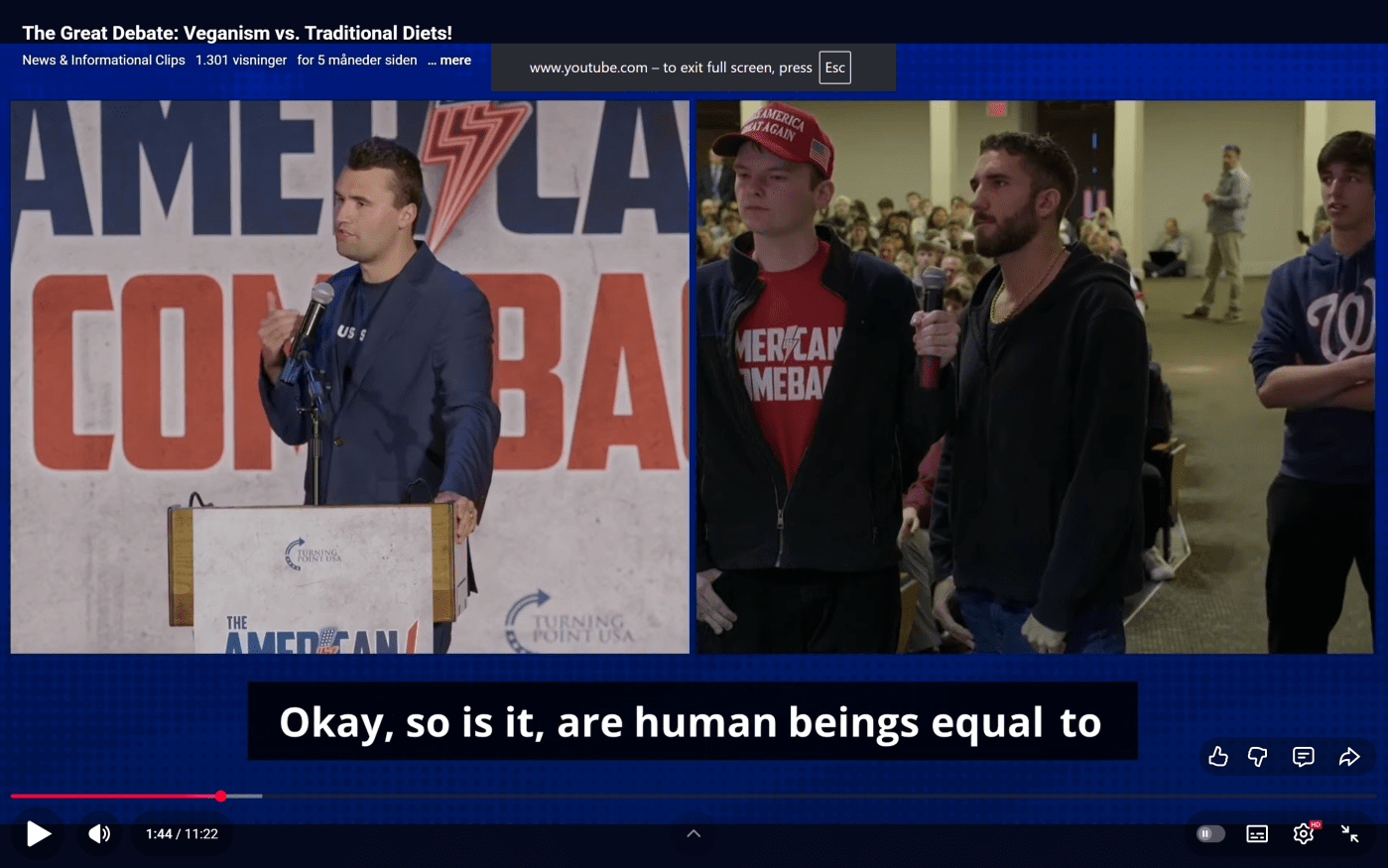
In a recent public exchange Charlie Kirk defended eating animals on biblical, biological, and practical grounds. His points deserve a careful hearing—and a careful answer—because morality is not decided by applause lines.
Kirk begins with the claim that humans are “above cows,” so killing them is not the same as killing a person. Greater intelligence, however, has never been a moral blank check. History is full of examples—slavery, colonialism, child labor—where the strong used their advantage to exploit the weak, only for later generations to condemn it. True moral superiority means protecting the vulnerable, not breeding and killing them for taste.
He also argues that the Bible permits meat, pointing to God’s permission to Noah after the flood and to Jesus feeding thousands with fish. Yet permission is not the same as moral ideal. Scripture tolerated polygamy and divorce without holding them up as eternal norms. The first dietary command in Genesis is plant-based, and prophetic passages such as Isaiah 11 imagine a peaceable kingdom without killing. Jesus feeding fish was a one-time act of emergency hospitality, not a divine endorsement of today’s factory farming.
Kirk next claims that eating animals isn’t cruelty if it nourishes us. That argument collapses in a modern society where plant proteins and simple B-vitamin supplementation supply every nutrient we need. When nourishment can be gained without bloodshed, killing becomes avoidable harm—which is precisely what cruelty means.
To support the idea of necessity, he warns that men need animal protein for testosterone and that soy lowers male hormones. But large peer-reviewed studies show no testosterone difference between vegans and meat-eaters when protein is matched. Phytoestrogens in soy act as modulators, not as female hormones, and elite athletes thriving on plant-based diets prove the point.
He further suggests that vegan eating is expensive and depends on processed “Frankenfoods” like Impossible Burgers. In fact, the cheapest proteins on earth are beans, lentils, oats, and potatoes. Meat itself is hardly “natural”: animals are bred, fed human-edible crops, medicated, trucked, and slaughtered before a steak reaches a plate.
Kirk also claims that meat is more “of the earth” than vegan food. Yet industrial animal agriculture is one of the most unnatural systems humans have built, with confinement sheds, chemical feed, antibiotic overuse, and vast manure lagoons. Eating plants directly is far closer to genuine farm-to-table living, and it avoids the waste of cycling crops through animals first.
Finally, he argues that without meat eating there would be fewer cows, as though the industry were doing animals a favor by bringing them into existence. Creating sentient beings for the sole purpose of confinement and slaughter is no gift. By that logic one could defend breeding humans for exploitation on the grounds that they were at least “given life.” Existence designed for suffering is not benevolence.
Every point Charlie Kirk raised—human superiority, biblical allowance, supposed nutritional need, fears about soy, claims about cost and naturalness, even the idea that we “give animals life”—collapses under scrutiny. And here Vaiṣṇava wisdom shows the fuller horizon.
The Vedic scriptures, far older than the Bible, teach that every living being is an eternal servant of God and therefore sacred. Non-violence toward animals is not a modern trend but part of eternal dharma, a principle beyond time and culture. While biblical texts include concessions for people living with scarcity and violence, Vaiṣṇava revelation discloses the lasting law of compassion that underlies all genuine religion. Kṛṣṇa accepts only offerings prepared in devotion and free from cruelty.
In this way Vaiṣṇavism does not dismiss biblical faith; it fulfills its deepest call to mercy and lifts it to its original, timeless standard. Even if one honors the Bible as divine, the higher path of Kṛṣṇa consciousness shows how humanity can now live—thriving without killing and offering food that pleases the Supreme Lord.
 Ajit Krishna Dasa
Leave a comment