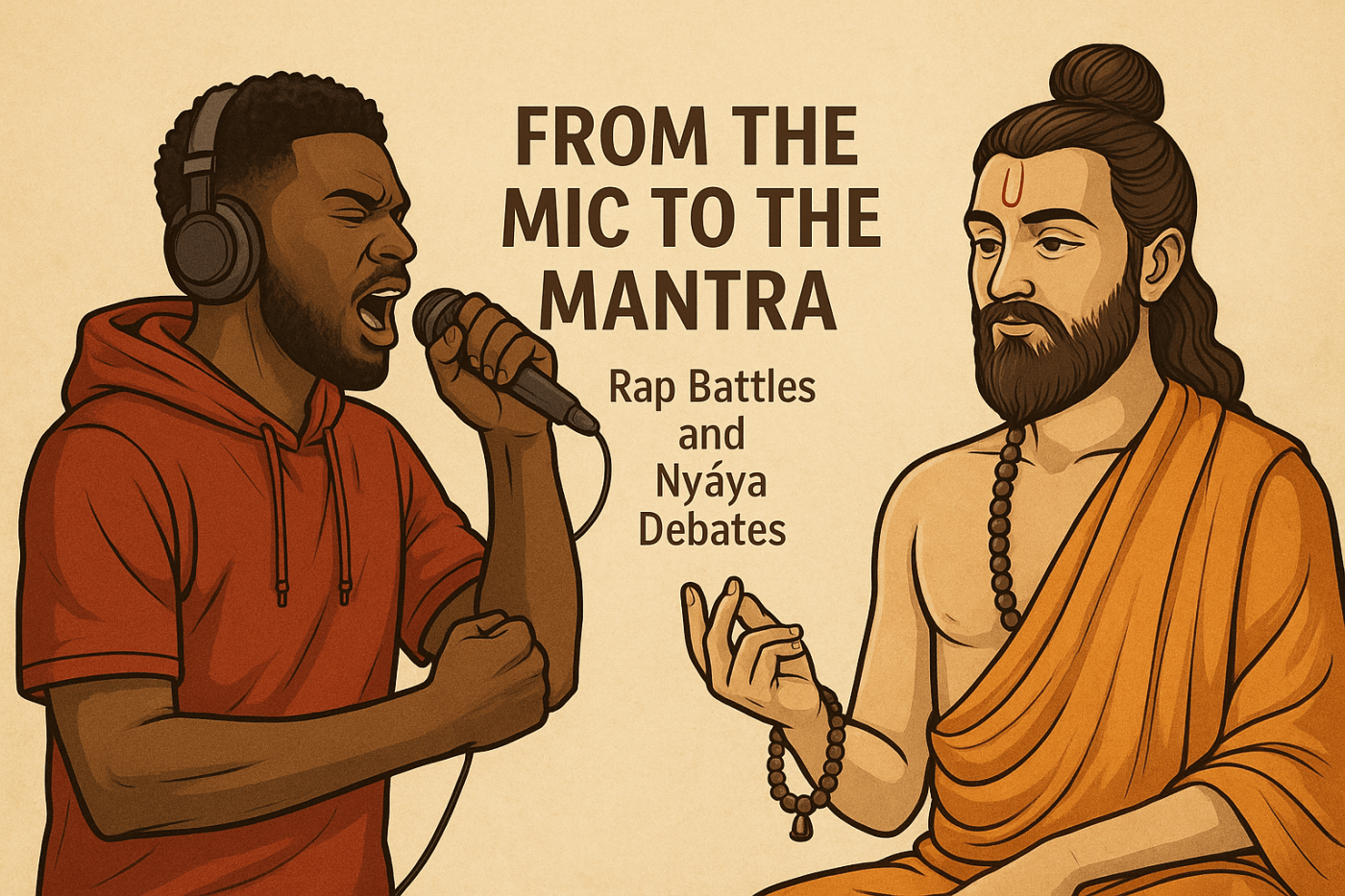
How the Art of Verbal Combat Can Evolve into a Practice of Clarity and Devotion
By Ajit Krishna Dasa
Hip hop – the Soundtrack of My Youth
Before I cared about meaning, I cared about rhythm. Long before I even knew the word hip hop, I was drawn to its sound — the pulse of the drums, the way a beat could make ordinary life feel charged with meaning. At first, I didn’t understand the lyrics. English wasn’t my first language, so I listened mainly to the energy — the flow, the emotion, the attitude. Later, as I learned more, the words began to open up: humor, storytelling, clever punchlines, social critique. It felt like a world — alive, expressive, real.
Hip hop offered what I was looking for: something raw and honest, something that didn’t pretend. It gave me role models — people who stood strong in the face of struggle. As a teenager, I absorbed everything: the beats, the messages, the heroes. For a time, hip hop was my whole world.
Then things shifted. I began to notice the darker layers — the violence, the ego, the obsession with sex, money and power. I started to see how the same force that gave the music its intensity also kept it trapped in anger and illusion. Around that time, I became interested in psychology and spirituality. My understanding of life — and of hip hop — began to change. I guess I just grew up. Some never do; they still see hip hop exactly as they did when they were fifteen.
For me, the underlying fascination didn’t die — it transformed. The rhythm I once admired on the outside became something I started to search for on the inside. What I’d loved in hip hop — its energy, honesty, and fearless defiance — began to feel like the shadow of a higher rebellion: the soul’s revolt against illusion.
That realization became the starting point for everything that follows — the journey from the mic to the mantra.
Where the Mic Meets the Mind
Rap battles and logic debates from the Nyāya schools of ancient India — Nyāya being one of the six classical systems of Indian philosophy devoted to reasoning, logic, and valid knowledge — come from worlds that seem to share nothing, one born from city streets, the other from the philosophical academies of India’s past. Yet both revolve around the same force: the human drive to articulate meaning through sound.
In hip hop, that drive becomes rhythm, wit, and lyrical dominance. In Nyāya philosophy, it becomes logic, inference, and revelation. One aims for applause; the other aims for liberation. But beneath both lies the same current of vibration — one that can either bind us in ego or free us in knowledge.
This essay explores how the passion of hip hop that fuels competition can, through understanding and yukta-vairāgya — the principle of renouncing nothing but using everything in service to God — be transformed into service. It explores how the mic, when offered in service to Krishna, the Supreme Person revered as the source of all beauty and consciousness, can echo the mantra, the sacred sound vibration used for spiritual realization.
From the Streets to the Ganges
A rap battle in the Bronx and an ancient debate on the banks of the Ganges, India’s holiest river and a symbol of purification, might look like they come from different planets. One moves on beats and bravado; the other on logic and calm. Yet both turn on the same power — the power of sound to reveal meaning.
Rap was born in the noise of broken cities. Rhythm became a kind of protest, rhyme a claim to existence. When an MC grabs the mic, it isn’t just to show skill. It’s to say, “I’m here. My voice counts.”
Long before that, Nyāya philosophers in ancient India gathered in courtyards and temples, doing their own kind of verbal sparring. Their weapons were syllogisms, and their aim was tattva — the ultimate truth or reality of things. For them, speech wasn’t just communication. Śabda, or sacred sound, was recognized as a genuine means of knowledge. Words didn’t create truth; they uncovered it.
So both worlds use language as a kind of weapon and mirror. The rapper battles the rival in front of him. The philosopher battles illusion – both inside the mind and in the outer world. One fights for applause, the other for the spiritual liberation of himself and others.
And that raises a question worth asking: can the same fire that fuels lyrical combat be purified and turned toward truth? Can the mic become a medium for awakening rather than a medium for selfish ego?
That’s the bridge — between the cypher and the sacred syllable, between the mic and the mantra.
The Power of the Word – The Creative Logos
Every culture has felt it: sound carries power. Words don’t just describe the world — they shape how we experience it. When used with awareness, they can lift the mind; when used carelessly, they can bind it.
In hip hop, this is obvious. A single bar can change a mood, challenge a system, or move a crowd. Rhythm and rhyme aren’t decoration — they’re engines of emotion and thought. The MC who masters them can turn sound into influence. That’s why the microphone feels almost sacred: it magnifies voice into presence, purpose and meaning.
The Vedic tradition begins from the same recognition but takes it further. The sages taught that sound, or śabda, is not merely human expression but a bridge between the material and the spiritual. In the Upaniṣads — the ancient philosophical scriptures exploring the nature of the self and ultimate reality — and in the Bhagavad-gītā, the revered dialogue between Krishna and the warrior Arjuna, sound is described as descending from a divine source. When Krishna speaks, His words are not opinion; they are revelation.
That’s a crucial difference. In hip hop, the power of the word comes from the artist’s will — a human attempt at ascending above limitation. In the Vedic view, real power comes when the word no longer belongs to the material ego. When sound serves truth rather than material self, it becomes śabda-brahman, the Absolute Reality descending and revealed through divine sound.
So both rapper and philosopher work with vibration. One expresses himself through it; the other effaces himself in it. One uses words to project, the other to perceive. Yet the energy at the root is the same: the longing for expression, for meaning, for release.
The question for the seeker is not whether to use sound, but whether to let sound use you.
The Nature of Combat – Ego’s Duel and Intellect’s Duel
Every confrontation of words begins with charge — two minds stepping into the same space, each determined to assert its power. But what’s being proven, and to whom, makes all the difference.
In a rap battle, the duel is personal. It’s ego versus ego — rhythm, wit, and crowd reaction as measures of supremacy. The MC’s weapon is style: confidence, timing, linguistic precision. The energy is rājasic, meaning it is driven by rajas, the mode of passion described in the Vedic texts — fiery, restless, and full of desire for achievement. Victory means dominance, not truth.
The ideal philosopher enters the arena differently. His weapons are reason and restraint. He battles not people but delusion — false inference, misperception, confusion. The motive isn’t applause but coherence. His satisfaction is not in being heard, but in seeing clearly.
Both battles draw from the same psychological well: the thrill of mastery. Whether it’s dropping the perfect rhyme or constructing a flawless syllogism, the brain delivers that same rush of completion — the subtle ecstasy of order born from chaos. That’s why both art forms feel alive: they turn confusion into clarity, noise into pattern.
The difference lies in direction. The rapper’s energy expands outward — seeking validation in the crowd. The philosopher’s energy turns inward — seeking freedom from illusion. One refines the performance; the other refines perception.
Yet the Vaiṣṇava path — the devotional tradition centered on loving service to Krishna or Vishnu — does not condemn that fire. It asks that it be consecrated. The same heat that once fueled egoic combat can, when offered to the Supreme, become the force that defends truth rather than the self. The duel remains — but its aim is no longer victory; it is purification.
What the Brain Loves About Battle
The electricity of a rap battle starts before the first word. The beat drops, and the nervous system catches fire. Long before anyone “wins,” the body already knows what’s happening.
Neuroscience maps the effect neatly. As rhythm hits the ear, the motor cortex and basal ganglia synchronize; your body begins to move before thought intervenes. Add competition, and dopamine floods the brain — the same neurochemical hit you get from scoring a goal or landing a punchline. It’s the biology of triumph, the chemical “yes” that powers creativity and competition alike.
An ideal logical debate activates a quieter version of the same network. When a philosopher solves a puzzle or spots a fallacy, dopamine still fires — not explosively, but steadily. The reward is slower, subtler, more sāttvic — marked by clarity, calm, and balance: understanding rather than conquest.
So the machinery is identical; only the mode of use changes. Hip hop stirs it through performance and rivalry; Nyāya awakens it through reasoning and insight. Both train focus and verbal fluency. One feeds identification with the false ego; the other gradually dissolves it.
For a Vaiṣṇava, a devotee in the Krishna/Vishnu tradition centered on loving service to the Supreme, this knowledge is practical. Passion isn’t evil — it’s energy awaiting direction. The same circuitry that ignites a crowd can be turned toward realization. When rhythm glorifies rather than provokes, when words reveal instead of impress, the brain still lights up — but the heart rests calm.
The Nyāya sages, teachers of that logic tradition, centuries earlier, had already mapped this impulse to compete — not with chemistry, but with philosophy.
Jalpa, Vitandā, and Freestyle Battles
The Nyāya sages dissected this very human appetite for contest and expression. They saw that not all debates are equal; what matters is the motive behind the words. To expose that difference, they classified debate into three modes: vāda, jalpa, and vitandā.
Vāda means sincere dialogue aimed at discovering truth. It’s the kind of debate where both sides seek understanding rather than victory. Jalpa means argument motivated by the desire to win — the rhetorical sparring that values triumph over truth. Vitandā goes further into distortion; it’s pure negation, attacking another’s position without defending any view of one’s own. Only vāda, said the sages, leads toward liberation, because it humbles the ego and refines the intellect.
Listen to a freestyle battle and you can hear jalpa come alive. The MC builds bars like syllogisms, flips logic into rhythm, and corners an opponent with verbal acrobatics. When he mocks without purpose, it slips into vitandā — clever destruction without offering light.
There’s a redeeming honesty in the cypher: everyone knows it’s a sort of game. The combat is stylized, a ritual of wit and rhythm. The audience enjoys the fire, not the illusion of truth. Still, the boundary isn’t always safe. Some take the art as war. A few battles spill from the stage into the street, turning words into wounds. That danger shows what happens when play becomes pride — when rājas hardens into rage.
In philosophical discourse, the same slide can occur more quietly. Egoic debate becomes dangerous precisely because it pretends to be sincere. When recognition replaces revelation, jalpa and vitandā become what the sages called a spiritual disease — energy corrupted by pride.
For the seeker, the lesson is simple but deep: the goal isn’t to silence the opponent but to silence illusion. The spontaneous sharpness that fuels freestyle can, when cleansed of hostility, evolve into the alert awareness of vāda — the calm, clear engagement of full attention without aggression.
The instinct to spar need not be suppressed; it must be sanctified. The same mental quickness that once entertained can now enlighten. When the mic is used to praise rather than to prove, language itself becomes liberation — the transformation of noise into nāma, the sacred name of God.
Vāda and Flow State
Every great freestyle artist knows the moment when thought disappears. Words come faster than intention; rhymes land before you consciously reach for them. That is the flow state — the brief erasure of the inner commentator. The MC becomes a channel for rhythm itself.
Philosophers experience something similar when vāda — honest, truth-seeking dialogue — reaches its peak. The mind becomes fully focused, free from distraction or aggression. The debater isn’t performing anymore; he’s listening — to reason, to revelation, to the structure of reality itself. The ego recedes because attention is total.
In neuroscience, both states show a similar pattern: the prefrontal cortex, which governs self-conscious control, quiets down. Creativity or insight flows not because the brain works harder, but because it stops interfering. In that stillness, language and logic find their natural rhythm.
The difference lies in what the silence serves. In freestyle, the self steps aside so art can emerge. In vāda, the self steps aside so truth can shine. One is aesthetic absorption; the other is spiritual absorption. Both are glimpses of freedom — but the latter points beyond the mind altogether.
This is why Nyāya debate, though it looks intellectual, is ultimately a kind of meditation. Its goal is not endless argument but the clear vision that ends argument — tattva-jñāna, direct knowledge of reality, of how things truly are beyond illusion.
For those who’ve known the rush of flow through rhyme, this comparison opens a new possibility: the same mental clarity that once produced wordplay can, when purified, become mantra-flow — effortless remembrance of Krishna, the Supreme Person, through sacred sound. It’s the same surrender of control, only now the current leads upward.
In rap, you lose yourself in rhythm. In vāda, you lose yourself in reason. In bhakti — the path of loving devotion to God — you lose yourself in love, and never feel lost again.
Yukta-Vairāgya: Sanctifying the Mic
When a person comes to spiritual life, there’s often a question: What do I do with everything I used to love? The beats, the rhymes, the performance — are they all to be thrown away? Vaiṣṇava philosophy — the devotional tradition that centers on loving service to Krishna, the Supreme Person — gives a clear answer: not necessarily. They must be purified, not abandoned.
The saint and theologian Rūpa Gosvāmī, a philosophical genius of the bhakti tradition who lived in 16th-century India, calls this principle yukta-vairāgya, meaning “linked renunciation.” It is the art of connecting all things to Krishna rather than rejecting them. In practice, it means using whatever exists — music, art, intellect, or energy — in God’s service, but without personal attachment. The test is simple: does it bring you closer to the Divine or strengthen the false ego? The same mic that once broadcast pride can, when offered, spread realization. The same rhythm that once fed anger can now awaken devotion.
The principle is universal. Krishna never asks us to destroy our nature; He asks us to offer it. A warrior becomes a protector. A thinker becomes a teacher. A performer can become a preacher — not necessarily through sermon, but through example. When art serves truth, it becomes śuddha-sattva, a state of pure spiritual goodness beyond material influence.
Of course, not every form of expression carries the same vibration. Hip hop’s natural mode is rājasic — the quality of rajas, one of the three modes of material nature described in the Vedic texts, characterized by passion, energy, and movement. It can easily pull consciousness outward. That’s why intention matters so much. A devotee using hip hop has to stay alert: the energy that elevates one person could distract another. The beat must bow to the holy name, not compete with it.
But if it’s done with sincerity, it works. The rhythm still moves the crowd, but the message moves the heart. The audience feels something more than excitement — they feel clarity, even peace. The performance becomes seva, selfless service to God. The MC becomes a messenger.
Yukta-vairāgya doesn’t mean standing apart from culture; it means transforming culture from within. To sanctify the mic is to remember that sound itself is sacred. Whether it’s Sanskrit mantra or English rhyme, when the vibration glorifies Krishna, it’s already transcendental.
Still, every form has its season. The Lord may accept this service for a time — as a bridge, a way to lift consciousness — and later guide the devotee beyond it. Hip hop, like all material art, belongs to the world of transformation; it is sanctified when used for God, but not eternal in itself. In the spiritual world, there are no battles of ego or fame — only loving exchanges of praise. Yet the essence of that energy — the joy of sound and expression — may reappear there in its purified form: spontaneous call-and-response, rhythmic glorification, and divine play, a joyful competition in glorifying Krishna ever more beautifully.
Thus, one’s attachment to rhyme and rhythm need not be crushed; it can mature into a higher taste for its eternal spiritual counterpart. What began as battle becomes kīrtana; what began as pride becomes offering. When the performer’s passion ripens into devotion, the mic itself turns toward eternity.
Rap Battle and Nyāya Debate – Two Paths of Speech
By now, the parallels are clear: both the rapper and the philosopher live by the word. Yet in their traditional forms their aims, motives, and effects lead in very different directions.
Purpose:
-In a rap battle, the goal is to win, impress, and entertain. The audience decides who dominates.
-In a Nyāya debate, the aim is to discover and establish truth (tattva-jñāna). Victory means clarity, not applause.
Motivation:
-The rapper moves from ego, artistry, and the hunger for recognition.
-The philosopher moves from sincerity — the desire to understand reality and escape illusion.
Relation to Truth:
-Rap uses words for impact; exaggeration or irony are part of the art.
-Nyāya treats words as sacred tools. Every claim must rest on sound reasoning and valid perception (pramāṇa).
Method:
-The rapper uses rhythm, rhyme, and wit — the flow itself is argument.
-The philosopher uses inference, definition, and evidence — logic is rhythm in the realm of reason.
Ethics of Speech:
-In a rap battle, personal attack is part of the game; deception can even win the crowd.
-In Nyāya, insult and trickery are considered chala — faults that corrupt the intellect. Respect is non-negotiable.
Psychological Tone:
-Rap burns with rajas — passion, movement, competitive energy.
-Nyāya shines with sattva — lucidity, calmness, discrimination.
Neural Reward:
-Rap releases fast dopamine — the instant pleasure of performance and social triumph.
-Nyāya offers slower satisfaction — the serenity that follows understanding.
Duration of Victory:
-The rap battle ends when the crowd cheers; its victory fades with the echo.
-The philosopher’s victory endures; truth remains true even when no one applauds.
Spiritual Potential:
-When used in devotion, rap can become seva through yukta-vairāgya — sound offered to Krishna.
-Nyāya is already aligned with sattva and becomes seva when practiced in humility.
Both disciplines purify speech, but toward different ends. Rap hones expression — the art of sound. Nyāya hones discernment — the art of seeing truly. The rapper wins by silencing others. The vāda philosopher wins by silencing illusion. And even when great Vaiṣṇava teachers seem to employ the form of jalpa, their motive remains pure vāda — to defend truth, not themselves. In the same spirit, when the fire that once fueled verbal combat is offered in service, the mic and the mantra no longer compete — they harmonize in the same eternal vibration of truth.
From Punchlines to Paramārtha
Every path of growth begins with the same spark — the wish to express what feels important and real. In the cypher, that truth takes the form of punchlines; in philosophy, it takes the form of reasoning. Both start from the same hunger: to speak what matters.
But as consciousness matures, the battlefield shifts. You realize that the real opponent isn’t the other rapper, the skeptic, or the critic — it’s the ignorance that covers the spiritual self. The old thrill of “owning” a moment becomes smaller than the quiet joy of seeing clearly.
This is the turn from loka-vijaya, meaning victory in the world or external success, to ātma-vijaya, victory over the self — conquering the material, false ego and illusion within. And beyond both lies paramārtha, the Sanskrit word for “supreme purpose” or “ultimate meaning”: the realization of truth that transcends worldly and personal victory alike. The word, once used to conquer others, now becomes the tool that frees the mind.
In Vaiṣṇava thought this is where all sound ultimately leads, and finds its root. Every syllable, every rhythm, every verse finds its perfection when it glorifies the Supreme Person. When that happens, speech stops being self-expression and becomes revelation — its original purpose restored. The mic becomes a conch shell, a symbol of divine proclamation, and the rhyme becomes nāma-saṅkīrtana, the congregational chanting of the Holy Names of God, the supreme sound vibration that restores the soul to its original nature of pure devotion to the Supreme Personality of Godhead, Shri Krishna.
The journey from rap battle to Nyāya debate in the vāda spirit is not a rejection of passion but its refinement. It’s the same energy, purified of pride and redirected toward truth. The pulse that once drove the beat matures into the rhythm of reason, and both find their perfection in the resonance of the divine mantra — all movements of one eternal sound that underlies them all.
In the end, the greatest line is not the one that wins applause, but the one that brings remembrance of Krishna, the all-attractive source of consciousness and love. That is the real victory — the rhyme that ends in realization. The beat and the mantra are not enemies; both are invitations to listen more deeply. The only question is whom we let the rhythm serve.
 Ajit Krishna Dasa
Leave a comment