By Ajit Krishna Dasa
Introduction: Not a Failure of Intelligence, but of Method
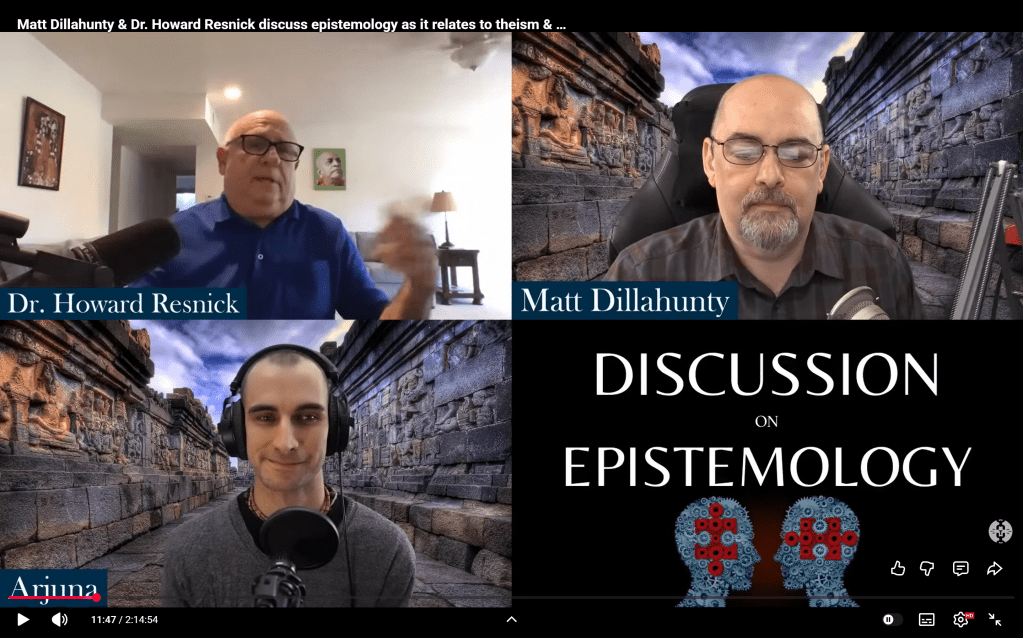
The debate between Hridayānanda Dāsa Gosvāmī and Matt Dillahunty, available on YouTube under the title “Hridayananda Dasa Goswami vs Matt Dillahunty”, presents, on the surface, an encounter between a learned Vaiṣṇava scholar and a seasoned atheist debater. Hridayānanda is articulate, educated, and well-versed in both Western philosophy and Vaiṣṇava theology. Dillahunty is sharp, disciplined, and relentless in his epistemological demands.
Yet despite Hridayānanda’s evident competence, the debate reveals a deeper problem. The issue is not that the Vaiṣṇava position lacks strength, nor that atheism is particularly compelling. The issue is methodological.
The foundation was conceded before the argument even began.
This article will demonstrate that Hridayānanda’s presentation fails not because of insufficient arguments, but because he accepts an epistemic framework that is fundamentally incompatible with Vaiṣṇava thought. As a result, even correct insights are rendered ineffective, and the discussion collapses into a form of reasoning that cannot sustain transcendental truth.
The First Concession: Autonomy of Reason
Early in the discussion, Hridayānanda affirms that human beings must “reason their way” to correct moral and philosophical understanding. While this may appear reasonable, it introduces a fatal shift.
In Vaiṣṇava epistemology, knowledge is not constructed from below through autonomous reasoning. It descends through śabda-pramāṇa—revealed knowledge transmitted through a reliable disciplic succession. Reason has a role, but it is subordinate. It clarifies, organizes, and defends—but it does not originate truth.
By presenting reason as an independent pathway to truth, Hridayānanda implicitly grants the atheist’s central assumption:
That human cognition is a sufficient and self-validating source of knowledge.
Once this is granted, the debate is no longer about whether Krishna is the Absolute Truth, but whether Krishna can be justified within a human-centered epistemology.
That is already a loss. Not because the conclusion is false, but because the standard of judgment has been misplaced.
The Euthyphro Trap: Morality Detached from God
In an attempt to avoid the charge of blind scriptural obedience, Hridayānanda suggests that actions are not moral merely because scripture commands them, but rather that they are found in scripture because they are moral.
This formulation aligns with the second horn of the classical Euthyphro dilemma: that morality exists independently of God.
But if morality is independent of God, then:
- God is no longer the source of moral truth.
- Moral standards exist prior to or outside of Him.
- Human beings may, in principle, access morality without revelation.
This undermines the very necessity of divine authority.
From a Vaiṣṇava standpoint, this is unacceptable. The proper understanding is neither that morality is arbitrary nor that it is external to God, but that it is grounded in His nature and will. Dharma is not discovered independently and then confirmed by scripture—it is revealed.
By conceding this point, Hridayānanda unintentionally grants the atheist a stable platform for moral reasoning without God.
The Collapse of Śāstra into Cultural Guidance
At several points, Hridayānanda suggests that certain scriptural injunctions may not be applicable in the present age. While contextual application is indeed acknowledged within the tradition, the manner in which this is presented in the debate shifts authority from revelation to human judgment.
Śāstra is no longer the standard—it becomes a resource to be evaluated..
This shift has profound consequences:
- Revelation becomes negotiable.
- Human reasoning becomes the final arbiter.
- Selective acceptance replaces submission.
From the atheist’s perspective, this is a gift. If scripture is merely culturally conditioned, then it no longer carries epistemic authority. It becomes one voice among many, to be evaluated and accepted or rejected based on independent criteria.
Thus, the debate is no longer about whether revelation is true, but whether it is useful.
Accepting the Atheist’s Epistemology
Matt Dillahunty consistently presses a single question:
“How can I tell that what you’re saying is true?”
This question presupposes a specific epistemology:
- Knowledge must be publicly verifiable.
- Claims must be testable or falsifiable.
- Truth must be accessible from a neutral standpoint.
Hridayānanda never challenges these assumptions. Instead, he attempts to answer the question within that framework.
This is a decisive error.
From a Vaiṣṇava perspective, there is no neutral standpoint. All knowledge rests upon foundational commitments. The demand for neutral verification is itself grounded in assumptions about reality, cognition, and truth that cannot be justified within atheism.
By accepting Dillahunty’s criteria, Hridayānanda places Krishna consciousness on trial before a court that has no authority to judge it.
The Failure of the “Spiritual Experience” Argument
In response to demands for verification, Hridayānanda appeals to spiritual practice:
By engaging in bhakti, one will come to realize the truth.
While this is correct within the tradition, it is presented in a way that appears indistinguishable from subjective religious claims.
From the atheist’s standpoint, this is easily dismissed:
- Other religions make similar claims.
- Personal experience is unreliable.
- The argument appears circular.
The deeper issue is not the appeal to experience itself, but the failure to establish why experience should be trusted at all within an atheistic framework.
A stronger approach would expose that:
- Atheism cannot justify the reliability of cognition.
- Therefore, it cannot dismiss spiritual experience without undermining its own epistemology.
Without this move, the appeal to experience remains vulnerable.
The Missing Step: A Transcendental Challenge
At no point does Hridayānanda press the decisive question:
On what basis does the atheist trust reason, perception, or logic?
Under atheism, human cognition is the product of unguided material processes aimed at survival, not truth. There is no guarantee that our beliefs correspond to reality. Indeed, if our faculties are shaped solely by evolutionary pressures, their primary function is adaptive success, not epistemic accuracy.
This leads to a profound problem:
If one’s cognitive faculties are not truth-oriented, then one has no reason to trust any belief—including atheism itself.
This is not a peripheral issue. It is foundational. It determines whether knowledge itself is possible.
A Vaiṣṇava response must begin here:
- Knowledge presupposes a conscious, truthful source.
- Rationality presupposes order and intelligibility.
- Truth presupposes an Absolute foundation.
Without Krishna, these are inexplicable.
The Result: A Strong Case, Built on Borrowed Ground
Hridayānanda presents many valid criticisms of atheism:
- its inability to ground morality.
- its reduction of consciousness.
- its existential implications.
Yet these arguments remain within a shared framework of autonomous reasoning.
As a result, atheism is treated as:
- a weaker explanation.
- an undesirable worldview.
But not as an impossible foundation.
This is the central failure.
A proper Vaiṣṇava response does not merely argue that atheism is insufficient. It demonstrates that atheism cannot account for the very tools it uses—reason, logic, and knowledge itself.
Who Won the Debate?
At the level of public perception, the answer is straightforward:
Matt Dillahunty won the debate.
He controlled the structure of the conversation, set the epistemological standards, and repeatedly pressed a single question:
“How can I tell that what you’re saying is true?”
This question, simple as it appears, defined the entire exchange. Hridayānanda accepted its underlying assumptions and attempted to answer it within the framework provided. From the standpoint of a neutral observer, the result was predictable: the Vaiṣṇava position appeared unable to meet the demanded criteria of justification.
In this sense, Dillahunty achieved what matters most in a debate setting. He maintained clarity, forced his opponent into a defensive posture, and exposed what appeared to be weaknesses in the theistic position. By conventional standards, this constitutes a victory.
However, this verdict must be qualified.
Dillahunty’s success was not the result of establishing a philosophically secure foundation for atheism. At no point did he justify:
- the reliability of human cognition.
- the validity of logical laws.
- the uniformity of nature required for scientific reasoning.
- the objective basis of truth or meaning.
These were simply assumed throughout.
Thus, while he won the debate procedurally, he did so by operating within a framework that itself remains ungrounded. The appearance of strength derives not from the completeness of his position, but from the fact that its presuppositions were never challenged.
This leads to a more precise assessment:
- Debate winner: Matt Dillahunty.
- Philosophical resolution: Unreached.
- Underlying issue: Conceded epistemological framework.
The decisive factor was not the strength of atheism, but the terms under which the discussion was conducted.
Hridayānanda did not lose because the Vaiṣṇava worldview lacks explanatory power. He lost because he argued for Krishna within a system that had already excluded Him as a necessary foundation for knowledge.
Once that concession is made, even strong arguments begin to work against their own conclusion.
The lesson is therefore not merely rhetorical, but foundational:
A transcendental position cannot be defended on borrowed epistemological ground.
Reconstructing the Exchange: What Should Have Been Said
The failure is not merely theoretical. It can be observed in concrete moments throughout the debate. By isolating a few key exchanges and reconstructing them as they should have unfolded, the extent of the epistemological concession becomes unmistakable—and the strength of a properly grounded Vaiṣṇava response becomes equally clear.
1. The Central Question: “How Can I Tell You’re Right?”
What was asked:
Dillahunty repeatedly pressed:
“How can I tell that what you’re saying is true?”
What was given:
An appeal to practice: engage in bhakti, and realization will come.
How it should have been answered:
Before answering that question, we must examine the assumptions behind it. You are asking for a method by which you can independently verify truth. But this presupposes that your cognitive faculties are reliable, that your reasoning is valid, and that your standards of verification are themselves trustworthy.
On what basis do you justify these assumptions?
If your mind is the product of unguided material processes aimed at survival rather than truth, then you have no non-circular reason to trust your conclusions. Your demand for verification already assumes a level of epistemic reliability that your worldview cannot account for.
Therefore, the issue is not whether you can verify Krishna within your framework, but whether your framework can justify the very act of verification.
2. The Moral Question: Is Good Independent of God?
What was implied:
In response to moral challenges, it was suggested that actions are not moral merely because scripture commands them, but that they are present in scripture because they are moral.
How it should have been answered:
That formulation assumes that moral standards exist independently of the Absolute. But if morality exists outside of God, then He is no longer its source, and moral truth becomes accessible without reference to Him.
From a Vaiṣṇava perspective, this is a false dilemma.
Morality is neither arbitrary nor external to God. It is grounded in His nature and expressed through His will. Dharma is not discovered independently and then confirmed by scripture—it is revealed by the Supreme Person, who is the source of all order, meaning, and value.
When you make moral judgments, you are not appealing to an autonomous standard. You are implicitly relying on an objective moral reality that requires a transcendent foundation.
Without such a foundation, moral claims reduce to preference, convention, or evolutionary conditioning—none of which can produce genuine obligation.
3. The Appeal to Experience: Is Bhakti Just Subjective?
What was said:
Spiritual realization comes through practice. By engaging in bhakti, one will come to understand.
How it should have been answered:
You dismiss spiritual experience as subjective, but on what basis do you trust any experience at all?
All knowledge—empirical or otherwise—depends upon the reliability of perception and cognition. Yet within your framework, these are the products of blind processes with no inherent orientation toward truth.
If you cannot justify the trustworthiness of your own experience, then you cannot selectively reject spiritual experience while accepting sensory or scientific experience. Both stand or fall together.
The question, therefore, is not whether spiritual realization is subjective, but whether your worldview can account for objective knowledge of any kind.
From the Vaiṣṇava standpoint, cognition is reliable because it ultimately rests upon a conscious, truthful source. Knowledge is possible because reality is grounded in an Absolute Person.
Without that foundation, all appeals to experience—scientific or otherwise—remain epistemologically unsupported.
What these reconstructions make clear is that the debate did not fail due to a lack of answers, but due to a failure to begin at the proper starting point. Once the epistemological foundation is secured, the entire structure of the discussion is transformed.
Conclusion: Representation Requires Foundation
A representative of the Gauḍīya Vaiṣṇava tradition must do more than present intelligent arguments. He must preserve the epistemological foundation upon which those arguments stand.
This means:
- Rejecting the myth of epistemic neutrality.
- Affirming the primacy of śabda.
- Exposing the internal contradictions of atheism.
- Demonstrating that Krishna is not an optional explanation, but the necessary ground of knowledge itself.
When this foundation is secured, the discussion changes entirely. The question is no longer whether Krishna can be proven within human reasoning, but whether human reasoning is possible without Krishna.
Hridayānanda’s debate shows what happens when this foundation is not maintained.
The lesson is clear:
The strength of the conclusion depends entirely on the integrity of the starting point.
And in matters of transcendental truth, the starting point cannot be compromised.
 Ajit Krishna Dasa