Trusting Our Senses and Cognitive Faculties for Knowledge

By Ajit Krishna Dasa

Our Vaisnava philosophy tells us that our senses and reasoning powers are limited and defective when it comes to gaining knowledge. Srila Prabhupada explains:

” … anyone born through the material energy must be subject to the four material deficiencies: bhrama (the tendency to commit mistakes), pramada (the tendency to be illusioned), vipralipsa (the tendency to cheat) and karanapatava (imperfect senses).”

Continue reading “Trusting Our Senses and Cognitive Faculties for Knowledge”

The Aroha and Avaroha Apologetic Methods

By Ajit Krishna Dasa

Question:

Paraphrasing a question that a devotee recently asked me:

“Theists often argue: “The whole material manifestation needs a Creator, because it could not have come about by itself. Therefore, a God must exist. To this atheists often respond: “If there needs to be a God, does He not also need a creator? And if God does not need a creator, then why does the material world need a creator?” How do we answer that?”

Answer:

You will get different answers according to the apologetic method used by those who answer. There are several apologetic methods, but as devotees we can categorize them as either belonging to 1) the aroha pantha (the ascending path) or 2) the avaroha pantha (the descending path).

Continue reading “The Aroha and Avaroha Apologetic Methods”

How to Talk to Atheists: (Part 2: Positions in Relation to the Existence of God)

Written by Ajit Krishna Dasa

Positions in Relation to the Existence of God

In How to Talk to Atheists Part 1 I made the argument that we as devotees have to avoid using the definitions of atheism given by atheists, and other non-believers of Vedic theism, and instead go with the definitions given by our revealed Vedic scriptures. Here in Part 2 I will shed some light on the respective positions that are possible to hold in regard to the questions of God’s existence.

Before we get into each individual position, please note:

Continue reading “How to Talk to Atheists: (Part 2: Positions in Relation to the Existence of God)”

How to Talk to Atheists (Part 1: Do Atheists Exist?)

Written by Ajit Krishna Dasa

How do we, as devotees of Krishna, figure out what an atheist – and what atheism – really is? 

-Do we search the internet? 

-Do we arm wrestle about it? 

-Do we just think really hard about it? 

-Do we consult a dictionary? 

-Do we ask an atheist? 

-Do we make an online survey? 

No, of course not. As devotees we look to sastra for an answer. Interestingly enough sastra says that there are no atheists! 

Continue reading “How to Talk to Atheists (Part 1: Do Atheists Exist?)”

Atheism, Theism and the Burden of Proof


By Ajit Krishna Dasa

When debating the existence of God atheists often claim that they do not have to lift a burden of proof. They argue that since atheism is nothing but the absence of belief in God it does not make any positive claims about the non-existence of God, and thus atheists have nothing to substantiate or justify when debating the existence of God.

Let us examine their claim carefully:

Continue reading “Atheism, Theism and the Burden of Proof”

The Non-Existence of Atheism

By Ajit Krishna Dasa

Atheism is non-existent because it is self-contradictory, the reason being that God and theism must first be accepted in order to argue in favor of atheism. 

How is that? 

The reason is that atheism cannot account for the universally existent and necessary preconditions of human cognition and intelligibility on which itself and all other wordviews are built. Now, what are these preconditions? Here follows a list of some of the most important ones:

Continue reading “The Non-Existence of Atheism”

Is God a Psychological Crutch?

By Ajit Krishna Dasa

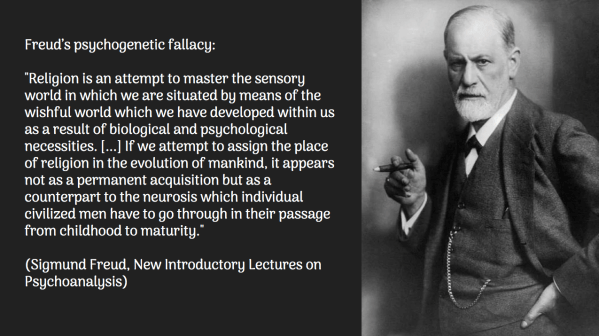
Atheists commonly argue against the existence of God by claiming that theists only believe in God due to psychological reasons. For example, Sigmund Freud, founder of the psychoanalytical school of psychiatry, claimed that religious belief is an obsessional neurosis, that God is nothing more than a psychological crutch, an illusion, a form of wishful thinking caused by human weakness.
Continue reading “Is God a Psychological Crutch?”

Website Powered by WordPress.com.

Up ↑