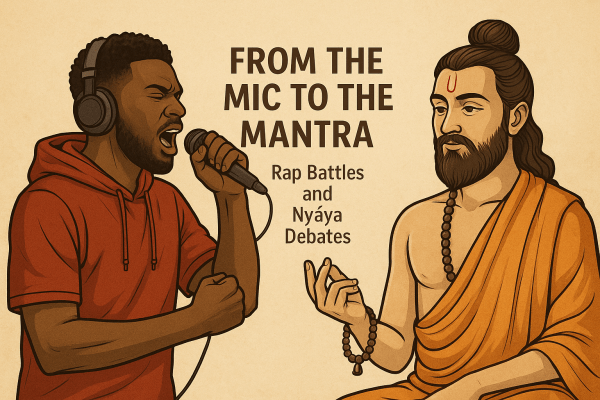
From the Mic to the Mantra: Rap Battles and Nyaya Debates

How the Art of Verbal Combat Can Evolve into a Practice of Clarity and Devotion

By Ajit Krishna Dasa

Hip hop – the Soundtrack of My Youth

Before I cared about meaning, I cared about rhythm. Long before I even knew the word hip hop, I was drawn to its sound — the pulse of the drums, the way a beat could make ordinary life feel charged with meaning. At first, I didn’t understand the lyrics. English wasn’t my first language, so I listened mainly to the energy — the flow, the emotion, the attitude. Later, as I learned more, the words began to open up: humor, storytelling, clever punchlines, social critique. It felt like a world — alive, expressive, real.

Hip hop offered what I was looking for: something raw and honest, something that didn’t pretend. It gave me role models — people who stood strong in the face of struggle. As a teenager, I absorbed everything: the beats, the messages, the heroes. For a time, hip hop was my whole world.

Continue reading “From the Mic to the Mantra: Rap Battles and Nyaya Debates”

A Vaisnavism Response to the Problem of the One and the Many

By Ajit Krishna Dasa

One of the most enduring questions in philosophy is the problem of the one and the many. How can unity and diversity coexist in a coherent way? Is reality ultimately one, or is it many? If only unity is real, how do we explain differences? If only plurality is real, how do we explain coherence, order, and meaning? Without reconciling these, knowledge and life itself become unstable.

Continue reading “A Vaisnavism Response to the Problem of the One and the Many”

How Vaisnava Epistemology Grounds an Effective Preaching Method

A Philosophical Framework for Understanding and Preaching Kṛṣṇa Consciousness with Fidelity to Vaiṣṇava Epistemology

By Ajit Krishna Dasa

Introduction: The Pre-experiential Ground of Knowing

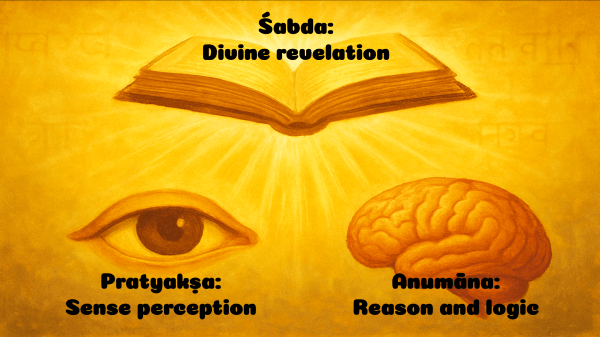
This paper presents a comprehensive framework for understanding Vaiṣṇava epistemology, intended especially for those engaged in the serious intellectual preaching work of Lord Caitanya Mahāprabhu’s mission. We will explore how knowledge begins not with inquiry, but with revelation—how śabda (divine testimony) is not a supplement to reason or perception, but the very ground upon which all rational thought, moral judgment, and empirical investigation rests.

Continue reading “How Vaisnava Epistemology Grounds an Effective Preaching Method”

Wanting God’s Kingdom Without God

By Ajit Krishna Dasa

Srila Prabhupada, the founder of the International Society for Krishna Consciousness (ISKCON), often pointed out a profound inconsistency in human thinking: “We want the kingdom of God without God.” This statement encapsulates a deep critique of materialistic worldviews, particularly those that seek the benefits of order, purpose, and meaning—attributes traditionally associated with the divine—while rejecting the very source of those qualities. From a Vaisnava perspective, which emphasizes the eternal relationship between the soul and Krishna, the Supreme Personality of Godhead, this contradiction reveals not only a philosophical error but also a spiritual blindness.

Continue reading “Wanting God’s Kingdom Without God”

The Dangers of So-called Neutrality in Preaching

By Ajit Krishna Dasa

The Danger of Adopting an Atheistic Approach

In preaching, I often see devotees of Krishna unknowingly abandon our Vaisnava worldview in favor of an atheistic epistemology. This tends to happen when we engage with atheists or those who rely solely on sense perception and logic—what the Vedic teachings call the aroha-pantha (the ascending path). In such discussions, devotees sometimes concede to the atheistic claim that their aroha-pantha approach is neutral and, therefore, scripture cannot be accepted as proof.

Continue reading “The Dangers of So-called Neutrality in Preaching”

The Ketchup Proof of God’s Existence

By Ajit Krishna Dasa

At your next vegetarian pizza party, as you reach for the ketchup to add that extra zest to your slice, consider the profound philosophical implications hidden in this simple act. Each squeeze of the bottle is not just an expectation of ketchup but a testament to the deep-seated, often unrecognized knowledge of God’s existence embedded within us. This seemingly trivial daily routine offers a compelling proof of God, rooted in the principles of Vaisnava presuppositional apologetics. Let’s delve into how this ordinary action reveals our innate awareness of a divine order governing the universe.

Continue reading “The Ketchup Proof of God’s Existence”

Dubito, ergo Deus est (I doubt, therefore God exists)

By Ajit Krishna Dasa

In the contemplative journey of epistemology, doubt serves not merely as a cognitive disturbance but as a profound engagement with the metaphysical inquiry into truth. In this presentation my aim is to explore doubt within the framework of Vaisnava presuppositionalism, thereby enriching both philosophical dialogue and spiritual insight. From the Vaisnava perspective, the process of doubting inexorably leads back to the Supreme Reality, Lord Krishna. This discourse explores how the act of doubting fundamental truths, such as the existence of God, paradoxically affirms His existence through the indispensable elements of truth, logic, and the uniformity of nature—all of which are manifestations of Krishna’s divine essence.

Continue reading “Dubito, ergo Deus est (I doubt, therefore God exists)”

What Is Presuppositionalism and Why Does It Matter for Vaisnavas?

By Ajit Krishna Dasa

Presuppositionalism is a way of looking at the world that asks: What needs to be true for us to make sense of anything? It focuses on the basic assumptions—or presuppositions—that shape how people see and interpret reality. These assumptions often go unnoticed, but they form the foundation for all our reasoning, beliefs, and experiences.

Continue reading “What Is Presuppositionalism and Why Does It Matter for Vaisnavas?”

Srila Prabhupada on the Logic of the Blind and the Lame

By Ajit Krishna Dasa

In his teachings, Srila Prabhupada sometimes invoked the andha-pangu-nyaya, or “the logic of the blind and the lame,” to illustrate how two limited parties can achieve success by cooperating. Through this metaphor, he conveyed the power of synergy, where limitations become strengths when aligned with Krishna consciousness. Here’s how Srila Prabhupada used this analogy and why it is a valuable tool in preaching Krishna consciousness.

Continue reading “Srila Prabhupada on the Logic of the Blind and the Lame”

Website Powered by WordPress.com.

Up ↑