Ricky Gervais’ Fallacy: A Vaisnava Critique of the “One Less God” Argument

By Ajit Krishna Dasa

Introduction: From Humor to Argument

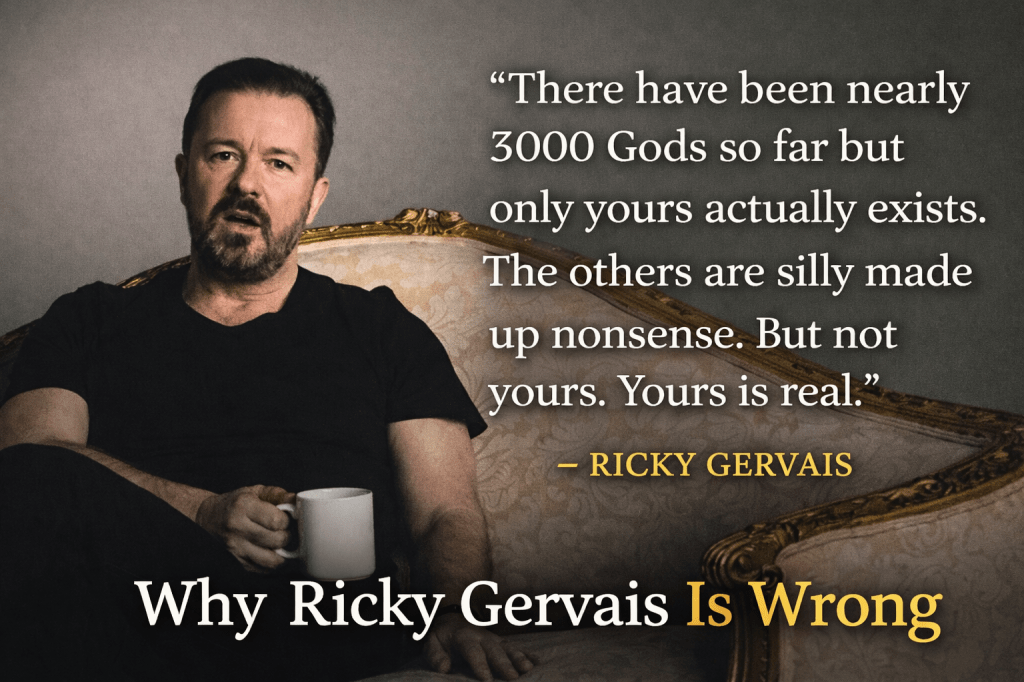
Public statements about religion are often delivered with a mixture of humor and provocation, and remarks by figures such as Ricky Gervais are no exception. His well-known line – that there have been thousands of gods, that the theist rejects all but one, and that the atheist simply goes one god further – is clearly intended, at least in part, as a comedic observation.

Nevertheless, the statement is widely received as more than humor. It is repeated as if it carries genuine philosophical weight. For that reason, it deserves to be examined with corresponding seriousness.

To be fair, the point is sometimes framed less as a strict denial and more as a challenge: that the theist has not provided sufficient reason to privilege one conception of God over others. This formulation is more modest, but it does not escape the underlying problem. It still assumes that all conceptions begin on equal epistemic footing and await external validation. Yet this assumption is precisely what is in question.

When examined carefully, the argument does not withstand scrutiny.

The Inflation of Disagreement

The first error lies in the inflation of disagreement. The existence of many religious conceptions is presented as if it establishes radical and irresolvable conflict at the most fundamental level. Yet this is not self-evident.

The argument depends on treating “gods” as if they were wholly separate and unrelated objects, as though one were choosing between entirely disconnected entities. But this is a simplification. What is often described as “many gods” is, in many cases, better understood as many competing descriptions of ultimate reality – descriptions that may be partial, distorted, or more or less adequate.

The disagreement, therefore, is not always between unrelated objects, but between rival accounts of what is taken to be the same underlying reality. To present this as total fragmentation is not neutral. It is a distortion.

Epistemic Leveling and Intellectual Negligence

The second error is epistemic leveling. All conceptions of God are treated as if they stand on equal footing – equally arbitrary, equally unsupported, equally dismissible. This assumption is not argued for; it is simply imposed.

Yet the differences between conceptions are not uniform. Some diverge significantly, offering radically different accounts of ultimate reality. Others, however, exhibit substantial overlap, differing not in their fundamental referent, but in the adequacy and completeness of their descriptions.

A Vaiṣṇava, for example, may find considerable agreement with Jewish, Christian, or Islamic conceptions of God. One may accept that there exists a single ultimate source of reality, that this source is powerful, intelligent, and transcendent, and that the world is dependent upon Him. The disagreement may concern specific attributes, relationships, or theological conclusions. In such cases, one may accept a large portion of the account—perhaps the majority—while rejecting what is judged to be incomplete or mistaken.

It is therefore misleading to describe such a position as the rejection of “another god.” More accurately, it is a refinement of a shared referent. What is rejected is not necessarily the object, but the adequacy of the description.

The crucial point is this: the field of religious concepts is not flat. It contains both deep divergence and significant convergence. To treat all conceptions as equally arbitrary is to ignore this structure entirely.

To do so is not intellectual rigor; it is intellectual negligence.

From Disagreement to Skepticism: A Non Sequitur

The third error is the inference from disagreement to skepticism. Even if one grants widespread disagreement, it does not follow that truth is inaccessible or that belief is unjustified.

Disagreement exists in every domain of inquiry, including science and philosophy. If disagreement were sufficient to suspend belief, then rational commitment of any kind would be impossible. The move from “many views” to “no truth” is therefore not an argument, but a non sequitur.

At most, disagreement invites further investigation. It does not license dismissal.

A Category Mistake: Confusing Description with Reality

At the root of the argument lies a deeper confusion. It treats differences in description as if they were differences in object.

To say that there are many conceptions of God is not the same as saying that there are many unrelated divine beings. It may instead indicate that human beings are attempting, with varying degrees of success, to describe a single ultimate reality.

To conflate these is a category mistake.

Once this mistake is corrected, the rhetorical force of the original claim disappears. One is no longer choosing randomly among thousands of disconnected options, but evaluating competing accounts of what may be the same underlying source.

The Metaphysical Rupture of Atheism

The claim that the atheist “just goes one god further” conceals a far more radical move. The theist does not merely select one option among many equivalent alternatives. He affirms that reality is grounded in an ultimate, intelligible source. The atheist, by contrast, removes this grounding entirely. This is not a quantitative difference. It is a metaphysical rupture. And once that rupture is made, the burden of explanation does not disappear. It intensifies.

The Burden of Explanation Remains

To deny God is not to eliminate the need for a foundation; it is to remove the most obvious candidate for one. The atheist must now account for the very conditions he continues to presuppose:

  • Why is reality intelligible rather than chaotic?
  • Why are the laws of logic universal and binding?
  • Why are causal relations stable?
  • Why does human cognition aim at truth rather than mere survival?
  • Why do moral claims present themselves as objectively valid?

These are not peripheral questions. They are the preconditions of rational discourse itself. Every argument – including the argument under consideration – presupposes them.

It is not sufficient to respond, “We do not yet know.” Ignorance may be tolerable in localized matters; it is fatal at the level of foundational conditions. For if one cannot account for the possibility of knowledge, one has no basis upon which to claim knowledge.

The argument borrows intelligibility while denying any sufficient account of it.

The Assumption of Uniform Access to Truth

A further assumption silently underwrites the entire argument. It assumes that if truth were present, it would appear uniformly, fully formed, and equally accessible to all observers. The existence of diverse conceptions is therefore taken as evidence against the existence of truth.

Yet this assumption is unwarranted.

In every other domain, knowledge is progressive and dependent upon the qualification of the knower. A child, a student, and an expert may all speak about the same subject, yet with varying degrees of clarity and accuracy. Their disagreement does not negate the subject; it reflects unequal understanding.

There is no reason to exempt knowledge of ultimate reality from this pattern.

Graded Understanding and the Hierarchy of Conceptions

The existence of many conceptions of God may therefore reflect not the absence of truth, but the uneven apprehension of it. Some conceptions may be partial, others distorted, and some more adequate to reality.

The presence of error does not undermine truth; it presupposes it.

From a theistic perspective, this is entirely coherent. If ultimate reality is such that it can be known, then it is reasonable to expect that it will be apprehended to different degrees, depending on the capacity and disposition of the knower.

The result is not a flat field of equally arbitrary options, but a hierarchy of conceptions – some shallow, some profound, some closer to the truth than others.

Once this is recognized, the appeal to “thousands of gods” loses its force. The question is no longer how many conceptions exist, but which of them adequately accounts for reality.

Conclusion: A Slogan Without Depth

The theist does not “believe in one god more.” He affirms that reality is grounded and intelligible, and that some conceptions of the divine succeed in accounting for this while others fail. The atheist, by contrast, denies any such grounding while continuing to rely upon the very conditions it would provide.

The difference is not small. It is absolute.

The popular formulation succeeds only by compressing complex philosophical positions into a slogan. It inflates disagreement, erases distinctions, and draws a conclusion that does not follow. Its persuasive force lies not in its depth, but in its simplicity.

Once examined, that simplicity is revealed as superficial.

What remains is not a profound insight, but a failure to think carefully about the very questions it pretends to resolve.
From Rules to Reality: Normativity and the Personal Ground of Order

By Ajit Krishna Dasa

One of the most revealing ways to understand the structure of reality is to begin somewhere unexpectedly simple: with rules.

Not the laws of physics.
Not moral commandments.
But the rules of a game.

What Are Rules Made Of?

Suppose someone invents a game and declares:

“You may only move two spaces.”

What has just come into existence?

Not a physical object.
Not merely a private thought.

A rule is a normative structure. It consists of:

  • meaning
  • intention
  • authority
  • the distinction between what counts as valid and invalid

It cannot be weighed or measured. Yet it is real. If a player moves three spaces, they are not just doing something different — they are doing something wrong relative to the game.

The rule is therefore:

  • non-material
  • not reducible to psychology
  • yet objectively binding within the system

This already shows something profound: reality includes non-physical but objective normativity.

From Games to Law

Human legal systems operate on the same ontological level, but with greater scope and force.

A law is not merely ink on paper. It is:

  • a meaning-bearing structure
  • grounded in intention
  • backed by recognized authority
  • normatively binding

It creates real obligations and rights. You cannot dissolve it into atoms and still retain the “ought.” Remove meaning, authority, and normativity, and you have paper, not law.

So again we find: objective realities exist that are not material.

The Leap Most People Miss

If non-material, objective norms exist at the level of games and societies, then the very idea that reality could contain non-material but objective structures is already established.

The real question is no longer:

“Can non-material norms be real?”

They already are.

The real question becomes:

“What is the ultimate ground of the most fundamental norms?”

Because beyond games and legal systems, we encounter deeper structures:

  • logical laws
  • mathematical necessity
  • moral obligation
  • stable natural order

These are not optional. One may opt out of chess. One cannot opt out of logic or causality and still function as a rational agent.

Laws of Nature as Normative Structure

In a strictly materialist worldview, the “laws of nature” are mysterious. Matter is supposed to be blind and indifferent. Yet reality behaves according to stable, intelligible, mathematically describable regularities.

Why should the universe conform to order at all?

Descriptions of patterns are not explanations of why patterns are binding.

In contrast, a personal theistic framework understands natural law not as an independent metaphysical principle, but as the stable mode of operation of divine energy.

Here we arrive at a classical Vaiṣṇava metaphysical insight: reality is grounded in a personal absolute whose energies operate in structured, ordered ways.

Energies, Not Mechanical Micromanagement

This does not imply that God manually pushes every particle. Rather, divine energies function according to consistent modes. Natural laws are the regular ways in which those energies operate.

They are:

  • not identical with God
  • not independent of God
  • dependent expressions of His power

This avoids two extremes:

Pantheism — nature is God
Deism — nature runs independently after creation

Instead, nature is ontologically dependent but functionally structured.

The Role of Acintya-bhedābheda

This relationship is described in Vaiṣṇava philosophy as acintya-bhedābheda — inconceivable simultaneous difference and non-difference.

Natural law is:

  • different from God (it is not His personal form)
  • non-different from God (it is His energy)

The stability of nature does not compete with divine personality. It expresses divine consistency.

Same Ontological “Type,” Different Ontological Rank

When humans create rules, we exercise a faint reflection of this structure. We too are conscious agents capable of generating normative systems. That is possible because we are conscious beings, not mere matter.

But the difference is absolute in scale:

Human RulesDivine Ground of Order
LocalUniversal
ContingentOntologically foundational
Dependent on acceptanceIndependent of creaturely recognition
TemporarySustained eternally

We do not ground reality. We participate in it.

The Final Picture

Normativity is not a theory. It is a condition of our experience.

Every act of reasoning, every rule we follow, every distinction between correct and incorrect presupposes that norms are real.

But norms are not material. No arrangement of particles contains “ought,” “valid,” or “counts as.” Normativity is irreducibly meaningful and intentional.

If reality were ultimately impersonal matter, normativity would have no ontological ground. Matter does not prescribe. It only behaves. It has no authority, no obligation, no correctness conditions.

Yet normativity is not optional. We cannot think, reason, argue, or judge without presupposing it.

Therefore, the issue is not whether normativity suggests a personal ground as a possible explanation. The issue is that without a personal ground, normativity becomes unintelligible.

The same structure appears at every level:

  • In games, rules determine what counts as a move.
  • In law, norms determine what counts as right or wrong.
  • In logic, principles determine what counts as valid reasoning.
  • In nature, stable order determines what counts as regular and lawlike.

These are not different kinds of things, but different depths of the same phenomenon: normative structure.

Human beings create local rules because we are conscious agents. But we do not ground the existence of normativity itself. We presuppose it.

The question, then, is not:

“Is a personal ground a good explanation for normativity?”

The question is:

How could normativity exist at all if the ultimate ground of reality were impersonal?

A purely mechanical foundation can describe what happens. It cannot account for what ought, what counts, what is valid, or what is correct.

Normativity therefore does not point upward as a clue. It presses downward as a precondition.

What we do in miniature when we establish rules presupposes a deeper reality in which normativity is not derivative but fundamental. That foundation cannot be less than mind-like. It must be personal.

Why God Allows Evil: The Masochism of the Soul

By Ajit Krishna Dasa

Introduction

The question is familiar, almost worn out by repetition: If God is all-good and all-powerful, why does He allow evil and suffering? Why should a child be born into war, a mother bury her son, or a man be driven to despair by loneliness, disease, or betrayal? And if such things are real—and they are—then how can we claim that this world is governed by a benevolent and omnipotent God?

Continue reading “Why God Allows Evil: The Masochism of the Soul”

Srila Visvanatha Cakravarti Thakura and the Transcendental Argument

By Ajit Krishna Dasa

Śrīmad-Bhāgavatam 10.87.2

Śukadeva Gosvamī said: ‘The Supreme Lord manifested the material intelligence, senses, mind and vital air of the living entities so that they could indulge their desires for sense gratification, take repeated births to engage in fruitive activities, become elevated in future lives and ultimately attain liberation.’”

Continue reading “Srila Visvanatha Cakravarti Thakura and the Transcendental Argument”

No God, No Logic: The Epistemic Suicide of Atheism

By Ajit Krishna Dasa

The Illusion of Neutral Logic

Many people—atheists and theists alike—believe that logic must be a valid epistemic tool simply because it cannot be denied without being used. “Even denying logic requires logic,” they say. “So logic must be valid.” This argument sounds compelling, but it is deeply flawed. It confuses necessity of use with justification. Just because something must be used does not mean it is grounded in truth.

Continue reading “No God, No Logic: The Epistemic Suicide of Atheism”

A Vaisnavism Response to the Problem of the One and the Many

By Ajit Krishna Dasa

One of the most enduring questions in philosophy is the problem of the one and the many. How can unity and diversity coexist in a coherent way? Is reality ultimately one, or is it many? If only unity is real, how do we explain differences? If only plurality is real, how do we explain coherence, order, and meaning? Without reconciling these, knowledge and life itself become unstable.

Continue reading “A Vaisnavism Response to the Problem of the One and the Many”

Religion, Fear, and the Reptilian Brain: Why People Reject God Before Understanding Him

By Ajit Krishna Dasa

It is important to acknowledge at the outset that many people have legitimate emotional and intellectual reasons to be suspicious of religion. Certain prominent theological systems promote the notion that God hates particular individuals or groups, withdraws His love from them, and condemns them to eternal punishment with no possibility of redemption. In such systems, divine love is conditional and retractable — and consequently, followers of these religions are often encouraged to withhold their compassion from those outside their belief system. This portrayal of God as selectively loving and eternally punitive leaves lasting psychological scars and colors the way many people instinctively react to any discussion of God or religion.

Continue reading “Religion, Fear, and the Reptilian Brain: Why People Reject God Before Understanding Him”

Western Words With Roots In Sanskrit

By Ajit Krishna Dasa

Did you know that many common English words are connected to Sanskrit — the ancient language of India?

We rarely stop to consider where our words come from. Language often feels like a tool we use, nothing more. But behind the words we speak lie centuries of memory, culture, and thought. 

One of the most surprising and overlooked roots in Western languages leads back to Sanskrit — the language that has carried India’s wisdom, philosophy, and poetry through the ages. And yet, it keeps reappearing, quietly, in everyday English.

Continue reading “Western Words With Roots In Sanskrit”

Create a website or blog at WordPress.com

Up ↑