What Is Presuppositionalism and Why Does It Matter for Vaisnavas?

By Ajit Krishna Dasa

Presuppositionalism is a way of looking at the world that asks: What needs to be true for us to make sense of anything? It focuses on the basic assumptions—or presuppositions—that shape how people see and interpret reality. These assumptions often go unnoticed, but they form the foundation for all our reasoning, beliefs, and experiences.

Continue reading “What Is Presuppositionalism and Why Does It Matter for Vaisnavas?”

Srila Prabhupada on the Logic of the Blind and the Lame

By Ajit Krishna Dasa

In his teachings, Srila Prabhupada sometimes invoked the andha-pangu-nyaya, or “the logic of the blind and the lame,” to illustrate how two limited parties can achieve success by cooperating. Through this metaphor, he conveyed the power of synergy, where limitations become strengths when aligned with Krishna consciousness. Here’s how Srila Prabhupada used this analogy and why it is a valuable tool in preaching Krishna consciousness.

Continue reading “Srila Prabhupada on the Logic of the Blind and the Lame”

Bursting the Bubble: The Froglike Thinking of Secular Scientists

By Ajit Krishna Dasa

Srila A.C. Bhaktivedanta Swami Prabhupada, the founder-acharya of the International Society for Krishna Consciousness (ISKCON), often used simple yet profound analogies to convey deep philosophical truths. One such analogy is that of the frog in the well, which illustrates the limitations of a narrow, materialistic perspective. In his teachings, Srila Prabhupada used this story to critique the pride and narrow-mindedness of those who try to understand the vastness of existence without acknowledging the Supreme Personality of Godhead, Krishna. The analogy challenges the assumptions of secular science and emphasizes that true knowledge begins with accepting God as the ultimate foundation of all reality. 

Continue reading “Bursting the Bubble: The Froglike Thinking of Secular Scientists”

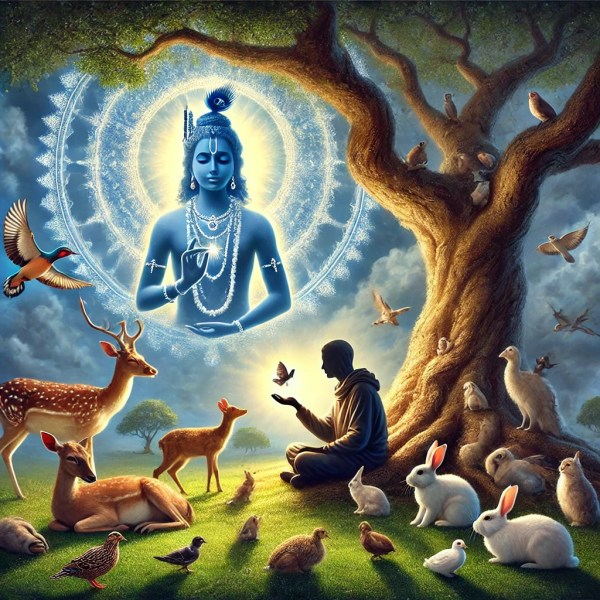
Are We Merely Animals? What Sets Humans Apart in Vedic Philosophy

By Ajit Krishna Dasa

Modern science has highlighted many similarities between humans and animals, such as the capacity for emotions, complex social behaviors, and even certain forms of intelligence. These findings have led some to conclude that humans are “merely” animals, suggesting there is nothing particularly special or unique about human existence compared to that of other species. This view tends to reduce human life to the same biological drives shared with animals—such as the pursuit of food, shelter, and reproduction—overlooking the profound differences that set us apart. From a Vedic perspective, while acknowledging these similarities, there remains a significant distinction: the human capacity for spiritual inquiry and self-realization.

Continue reading “Are We Merely Animals? What Sets Humans Apart in Vedic Philosophy”

Website Powered by WordPress.com.

Up ↑