When Criticizing Women Becomes a Blind Spot

By Ajit Krishna Dasa

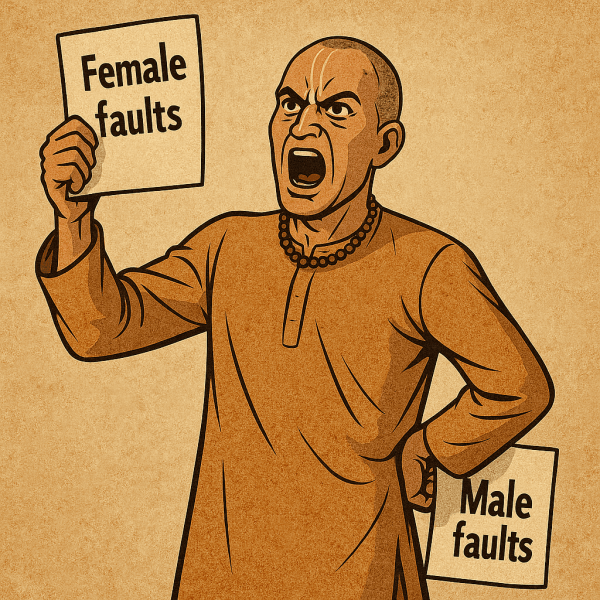
In some devotional discussions, it has become fashionable to list the “faults of women” — often using long, sensationalized narratives about female manipulation, deception, instability, or hidden agendas. These narratives present themselves as “traditional” or “strict,” but they rely on selective quotation and ignore something fundamental:

Śāstra gives at least as many — and often far harsher — warnings about the faults of men.

Continue reading “When Criticizing Women Becomes a Blind Spot”
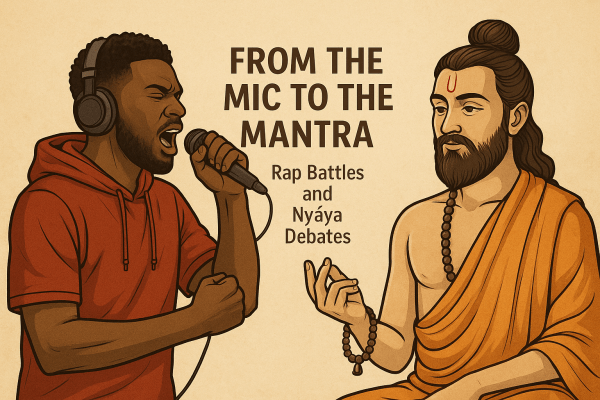
From the Mic to the Mantra: Rap Battles and Nyaya Debates

How the Art of Verbal Combat Can Evolve into a Practice of Clarity and Devotion

By Ajit Krishna Dasa

Hip hop – the Soundtrack of My Youth

Before I cared about meaning, I cared about rhythm. Long before I even knew the word hip hop, I was drawn to its sound — the pulse of the drums, the way a beat could make ordinary life feel charged with meaning. At first, I didn’t understand the lyrics. English wasn’t my first language, so I listened mainly to the energy — the flow, the emotion, the attitude. Later, as I learned more, the words began to open up: humor, storytelling, clever punchlines, social critique. It felt like a world — alive, expressive, real.

Hip hop offered what I was looking for: something raw and honest, something that didn’t pretend. It gave me role models — people who stood strong in the face of struggle. As a teenager, I absorbed everything: the beats, the messages, the heroes. For a time, hip hop was my whole world.

Continue reading “From the Mic to the Mantra: Rap Battles and Nyaya Debates”

Why God Allows Evil: The Masochism of the Soul

By Ajit Krishna Dasa

Introduction

The question is familiar, almost worn out by repetition: If God is all-good and all-powerful, why does He allow evil and suffering? Why should a child be born into war, a mother bury her son, or a man be driven to despair by loneliness, disease, or betrayal? And if such things are real—and they are—then how can we claim that this world is governed by a benevolent and omnipotent God?

Continue reading “Why God Allows Evil: The Masochism of the Soul”

Self-Deception and Vaisnava Theology: Understanding the Soul’s Will to Forget

By Ajit Krishna Dasa

Why do we turn away from truths we already know deep inside? Vaiṣṇava theology describes self-deception not as innocent ignorance but as the soul’s conscious attempt to forget its eternal role as Kṛṣṇa’s servant. Out of envy and the desire for independence, we suppress reality, and māyā gently provides the illusions that make the lie livable. At our core, we still know Kṛṣṇa, yet on the surface we resist Him, creating contradictions—like atheists who rely on morality and reason that only make sense if God exists. This self-deception fuels saṁsāra, false philosophies, and even subtle ambition within spiritual life. But bhakti offers the cure: not gaining new knowledge, but removing the coverings that hide the truth we already carry. Through honesty, humility, and hearing from Śrīla Prabhupāda’s books, the soul’s real identity begins to shine again.

Continue reading “Self-Deception and Vaisnava Theology: Understanding the Soul’s Will to Forget”

Srila Visvanatha Cakravarti Thakura and the Transcendental Argument

By Ajit Krishna Dasa

Śrīmad-Bhāgavatam 10.87.2

Śukadeva Gosvamī said: ‘The Supreme Lord manifested the material intelligence, senses, mind and vital air of the living entities so that they could indulge their desires for sense gratification, take repeated births to engage in fruitive activities, become elevated in future lives and ultimately attain liberation.’”

Continue reading “Srila Visvanatha Cakravarti Thakura and the Transcendental Argument”

No God, No Logic: The Epistemic Suicide of Atheism

By Ajit Krishna Dasa

The Illusion of Neutral Logic

Many people—atheists and theists alike—believe that logic must be a valid epistemic tool simply because it cannot be denied without being used. “Even denying logic requires logic,” they say. “So logic must be valid.” This argument sounds compelling, but it is deeply flawed. It confuses necessity of use with justification. Just because something must be used does not mean it is grounded in truth.

Continue reading “No God, No Logic: The Epistemic Suicide of Atheism”

Rewriting Krishna’s Reality?

By Ajit Krishna Dasa

People love to act like they can make up reality as they go. They change their pronouns, call themselves a different gender or species — as if simply declaring it could make it true. They do the same with morality: deciding abortion isn’t murder if they call it “choice,” or hookup culture isn’t empty if they call it “freedom.” Every one of these moves comes from the same deep root — the desire to define reality on their own terms. And that’s a dead giveaway that they want to take God’s position. They want the power to say what is real and what is right.

Continue reading “Rewriting Krishna’s Reality?”

A Vaisnavism Response to the Problem of the One and the Many

By Ajit Krishna Dasa

One of the most enduring questions in philosophy is the problem of the one and the many. How can unity and diversity coexist in a coherent way? Is reality ultimately one, or is it many? If only unity is real, how do we explain differences? If only plurality is real, how do we explain coherence, order, and meaning? Without reconciling these, knowledge and life itself become unstable.

Continue reading “A Vaisnavism Response to the Problem of the One and the Many”

Website Powered by WordPress.com.

Up ↑