The Foundation of Knowledge in a Vaishnava vs. Atheistic Worldview

By Ajit Krishna Dasa

Epistemology, the study of knowledge, grapples with fundamental questions about how we know what we know and whether our beliefs are justified. Throughout history, various philosophical systems have sought to provide answers to these questions, ranging from rationalism and empiricism to skepticism and postmodern relativism. However, underlying all these systems is a critical debate:

Can human beings build a coherent and reliable epistemology apart from a Supreme Godhead?

Continue reading “The Foundation of Knowledge in a Vaishnava vs. Atheistic Worldview”
How to Talk to Atheists (Part 1: Do Atheists Exist?)

Written by Ajit Krishna Dasa

How do we, as devotees of Krishna, figure out what an atheist – and what atheism – really is? 

-Do we search the internet? 

-Do we arm wrestle about it? 

-Do we just think really hard about it? 

-Do we consult a dictionary? 

-Do we ask an atheist? 

-Do we make an online survey? 

No, of course not. As devotees we look to sastra for an answer. Interestingly enough sastra says that there are no atheists! 

Continue reading “How to Talk to Atheists (Part 1: Do Atheists Exist?)”

Materialists Cannot Prove the Existence of Matter

By Ajit Krishna Dasa

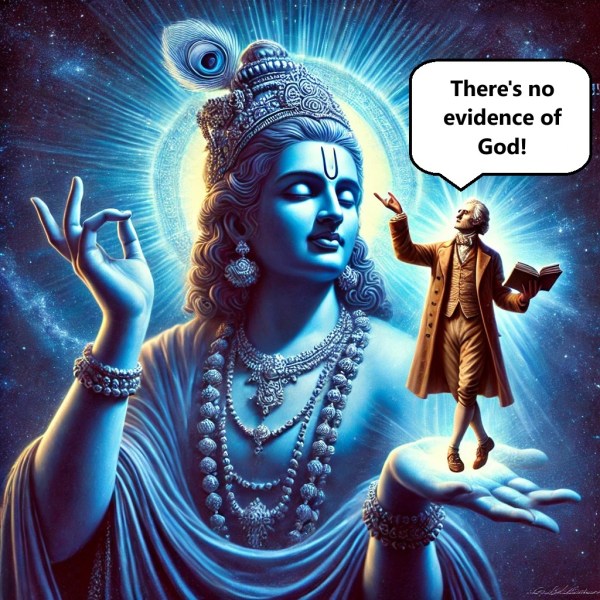
According to most atheists there is no evidence to support the idea that something spiritual or divine exists. They claim that matter is all we can observe, and that theists are irrational and naive victims of their own wishful thinking. Since there is no proof of spirit, they claim, we should all be materialists.

But the atheists are wrong, and here is why: Continue reading “Materialists Cannot Prove the Existence of Matter”

The Self-Contradictory Claim of God’s Nonexistence

By Ajit Krishna Dasa

Anyone declaring “God does not exist” winds up contradicting him- or herself in at least four significant ways:

1) By inadvertently supporting the existence of objective values

Imagine this: an atheist boldly claims, “God does not exist.” In doing so, he’s not just speaking—he’s choosing. He’s decided to make this particular statement over countless other things he might have said or done. In effect, he’s valuing this assertion above all other actions. But here’s the twist: Continue reading “The Self-Contradictory Claim of God’s Nonexistence”

Website Powered by WordPress.com.

Up ↑