By Ajit Krishna Dasa
This article is part of the series “From Bhakti to Self-Development,” examining the growing tendency to present Krishna consciousness as a form of modern self-help spirituality.
Introduction
In recent decades, spirituality in the West has undergone a noticeable transformation. Ancient traditions are increasingly repackaged as tools for personal development, psychological balance, and self-optimization. Meditation promises emotional regulation. Mindfulness improves productivity. Spiritual reflection becomes a method for living a more “conscious lifestyle.” In this cultural environment, religion is rarely presented as revealed truth demanding surrender. Instead, it is offered as a resource for improving one’s mental state and quality of life. This shift has not left Krishna consciousness untouched.
This shift has not only affected secular adaptations of yoga and meditation. It has begun to influence the way even explicitly devotional traditions are presented. Practices rooted in theological commitments are gradually reframed as techniques for personal well-being. The language remains spiritual, but the center of gravity moves from devotion to self-improvement.
The Conscious Lifestyle and the Therapeutic Reframing of Spirituality
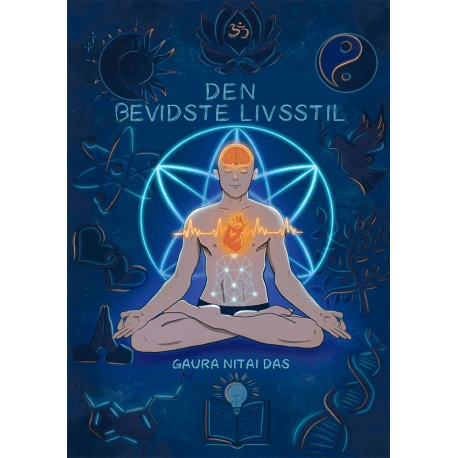
A striking example of this development appears in the Danish book The Conscious Lifestyle (Den Bevidste Livsstil) by Gaura Nitai Das, currently available only in Danish.
Even the book’s cover visually reflects this orientation. The artwork depicts a meditating human figure surrounded by symbols drawn from a wide range of spiritual and scientific traditions—an atom, a DNA strand, a yin-yang symbol, a dove, and other universal motifs. The imagery suggests a synthesis of spirituality, psychology, and scientific self-improvement rather than a presentation rooted in a specific theological tradition. Krishna or devotional imagery is notably absent. The visual message therefore mirrors the conceptual framework of the book itself: spirituality presented as a universal system for personal transformation rather than devotion to a particular Supreme Person. In a book drawing heavily on the Krishna conscious tradition, the complete absence of Krishna from the visual symbolism is itself revealing.
The message becomes even clearer on the book’s back cover. Here the reader is told that happiness and quality of life depend primarily on the “state of one’s consciousness,” and the book promises to show how thoughts, emotions, and experiences can permanently transform our “genetic state.” The language is unmistakably that of modern self-optimization culture: consciousness is something to be engineered, experiences become tools for biological transformation, and spirituality functions as a method for improving personal well-being. Once again, the emphasis falls not on devotion to Krishna but on the cultivation of an optimized inner state.
The author draws heavily on concepts from Vedic philosophy and the Krishna conscious tradition, and his admiration for those teachings is evident throughout the work. Yet the framework through which these ideas are presented reveals something troubling: the Krishna consciousness described in the book is immature and theologically underdeveloped. Instead of presenting bhakti as the ultimate truth of existence, the book repeatedly reframes spiritual ideas as tools for psychological well-being and lifestyle design.
The result is not an open rejection of Krishna consciousness. It is something more subtle: its domestication.
The book’s central project is to encourage readers to live more consciously, reflect on life’s deeper questions, and integrate spiritual perspectives into everyday life. Themes such as mortality, meaning, discipline, and ethical awareness are explored through a mixture of personal anecdotes, philosophical reflections, and references to Vedic texts. The tone is conversational and accessible, clearly aimed at readers interested in personal growth rather than formal theology.
One remark in the book makes this orientation particularly clear. At one point the author suggests that spiritual ideas may be valuable even if their truth remains uncertain, because of the positive psychological effects they can produce in human life.
This claim is deeply revealing. Once spiritual teachings are justified primarily by their psychological benefits, their truth becomes irrelevant. Religion is no longer a revelation about reality but a technique for managing human experience. At that point, Krishna consciousness ceases to be a theological tradition and becomes a therapeutic framework. What matters is no longer whether Krishna exists, but whether believing in Him produces desirable emotional states.
At first glance, this approach may seem harmless. Encouraging people to reflect on life, death, and spiritual questions is certainly not objectionable. The difficulty lies in the conceptual framework through which the spiritual teachings are introduced. Throughout the book, beliefs about the soul, God, and life after death are often framed in terms of the psychological perspective they offer rather than their objective truth. Spiritual ideas function as resources for reducing existential anxiety, creating meaning, and cultivating psychological balance.
This shift reveals the underlying problem.
From Devotion to Self-Optimization
In the Gaudiya Vaisnava tradition, as presented by Srila Prabhupada, spiritual teachings are not justified by their psychological usefulness. They are presented as revealed knowledge describing the actual nature of reality. The soul exists. Krishna exists. The relationship between them is real. Devotional practice is meaningful because it aligns human life with that reality.
In The Conscious Lifestyle, however, this order is quietly reversed. Spiritual beliefs are recommended because they help people live better lives. The truth of those beliefs becomes secondary. This pattern reveals a thin interpretation of Krishna consciousness. Instead of presenting bhakti as the ultimate goal of life, the tradition is reduced to a set of practices that help individuals cope with modern anxieties. The result resembles a beginner’s encounter with spiritual culture – fascinated by its concepts and aesthetics, but not yet grounded in its theological depth or metaphysical seriousness.
What emerges is not Krishna consciousness in its classical form, but a conceptually diluted and shallow presentation of the tradition.
The same shift appears in the book’s treatment of spiritual practice. Throughout the text, practices associated with devotional life are frequently framed as methods for cultivating awareness, regulating emotions, or improving one’s mental state. Meditation, contemplation, and reflection are described as tools for stabilizing consciousness and gaining perspective on life.
Within such a framework, spiritual disciplines begin to resemble the techniques commonly found in modern self-help literature. They become methods for managing the mind rather than acts of devotion directed toward the Supreme Person.
Nowhere is this shift more significant than in the implicit treatment of chanting. In the Gaudiya Vaisnava tradition, chanting the holy names of Krishna is not a meditation technique. It is the central act of devotional life. Srila Prabhupada never presented chanting as a technique for improving mental well-being or cultivating psychological balance. He presented it as the direct process of associating with Krishna Himself. The holy name is not a sound used to regulate consciousness; it is Krishna personally present in transcendental vibration. The holy name of Krishna is understood to be non-different from Krishna Himself. When a devotee chants, he is not merely repeating a sound to regulate his consciousness. He is engaging in direct association with the Supreme Lord.
In the cultural grammar of modern spirituality, however, chanting easily becomes reinterpreted as a form of meditative repetition. It is seen as something that helps calm the mind, deepen awareness, or cultivate inner balance. The focus shifts subtly but decisively from Krishna to the practitioner’s internal experience.
This is not a minor adjustment in terminology. It represents a fundamental theological displacement.
When chanting becomes meditation, the heart of bhakti disappears.
A similar dynamic appears in the book’s use of modern scientific language. References to neuroscience and neurotheology are introduced in order to illustrate that spiritual contemplation may produce measurable effects in the brain. These references are brief and largely rhetorical, but their function is clear: they reinforce the idea that spiritual practices are valuable because they generate beneficial psychological outcomes.
Once again the question quietly shifts from “What is true?” to “What works?”
This is precisely the logic of the self-optimization culture that dominates contemporary spirituality. Practices are adopted because they improve mental performance, reduce stress, or generate positive emotional states. Religion becomes a technology for managing consciousness.
From a Vaisnava perspective, however, this entire framework is misguided. The purpose of spiritual life is not the optimization of psychological states. It is the awakening of love for Krishna. The peace, clarity, and stability that may arise in devotional practice are not its goal. They are simply natural byproducts of engaging in a relationship with the Supreme.
The difference may appear subtle, but it marks the boundary between devotion and self-help.
Perhaps the most revealing aspect of The Conscious Lifestyle is that it does not openly oppose Krishna consciousness. On the contrary, the book expresses admiration for Vedic philosophy and devotional culture. The author’s personal journey clearly reflects genuine spiritual searching.
Yet sincerity alone does not guarantee theological clarity. The Krishna consciousness presented in the book remains unripe and theologically incomplete. Instead of presenting the tradition with the confidence of revelation, it frames its teachings in the cautious language of psychological usefulness.
When Bhakti Becomes Lifestyle
When devotional traditions are translated into the language of self-optimization, their center inevitably shifts. The practitioner no longer approaches God in a mood of surrender but approaches spiritual practices as tools for improving personal experience. Krishna becomes one resource among many in the project of self-development. The language of devotion may remain intact, but the orientation of the practice has quietly changed.
This shift has serious consequences for preaching. If Krishna consciousness is presented primarily as a tool for improving psychological well-being, then the tradition loses its unique claim. Many philosophies, therapies, and spiritual systems promise similar benefits. The distinctive feature of Gaudiya Vaisnavism is not that it helps people feel better, but that it reveals the eternal relationship between the soul and Krishna. When that claim is softened or replaced by therapeutic language, the tradition gradually dissolves into the broader marketplace of self-help spirituality.
This often happens when devotees lose confidence in presenting Krishna consciousness as it is. Faced with a modern audience skeptical of metaphysical certainty, they attempt to make the tradition more accessible by translating it into the language of personal development. Krishna consciousness becomes a path to emotional balance, clarity of mind, or conscious living.
But when bhakti is repackaged as a form of self-optimization, its essential message is lost.
Krishna consciousness does not exist to improve our lifestyle. It exists to transform our identity. The living being is not a psychological system seeking better mental states. He is an eternal servant of Krishna whose real fulfillment lies in loving devotional service to the Supreme Person.
For this reason, the most powerful presentations of the tradition have always been those that speak with theological confidence. Srila Prabhupada did not present chanting as a technique for reducing stress. He presented it as the direct means of associating with Krishna. He did not justify devotion by appealing to psychological benefits. He justified it because Krishna is the Supreme Reality. Srila Prabhupada did not travel the world teaching a method for emotional well-being; he taught that human life is meant for reviving our forgotten relationship with Krishna and returning to the spiritual world.
The difference between these two approaches is the difference between devotion and self-help spirituality.
The Conscious Lifestyle illustrates how easily the latter can absorb the former. What begins as an attempt to make spiritual teachings accessible gradually turns Krishna consciousness into one component within a broader philosophy of conscious living.
Devotion becomes lifestyle design. Bhakti becomes personal development. Krishna becomes optional.
For readers familiar with the teachings of Srila Prabhupada, this shift should raise serious concerns. A tradition centered on surrender to the Supreme Person cannot be faithfully represented if its teachings are reduced to techniques for improving one’s psychological condition.
In that sense, the book stands as a revealing document of a broader trend within modern spirituality. It shows how even sincere spiritual seekers may unintentionally dilute the very tradition that inspired them. A tradition centered on surrender to the Supreme Person cannot survive if it is repeatedly translated into the language of self-improvement and psychological optimization. When devotion becomes a lifestyle technique, its object gradually disappears.
Krishna consciousness deserves better than this.
It deserves to be presented not as a helpful philosophy of conscious living, but as what it actually claims to be: the eternal truth about the relationship between the soul and the Supreme Personality of Godhead.
 Ajit Krishna Dasa