The Ground of Knowing: Why Ontology and Epistemology Are Inseparable in Vaisnava Presuppositionalism

By Ajit Krishna Dasa (Denmark)

The accusation that presuppositionalism confuses ontology (what exists) with epistemology (how we know what exists) stems from a misunderstanding of the relationship between these two concepts. Presuppositionalists, especially from a Vaisnava perspective, would argue that this relationship is not a confusion but a necessary interconnection. Let’s break it down:

Continue reading “The Ground of Knowing: Why Ontology and Epistemology Are Inseparable in Vaisnava Presuppositionalism”

Srila Prabhupada on the Logic of the Nipples on the Neck of a Goat.

By Ajit Krishna Dasa

Srila Prabhupada often employed traditional Indian logic and analogies in his preaching to help his audience grasp profound philosophical concepts. One such analogy he used is the Aja-gala-stana-nyaya, or the logic of the nipples on the neck of a goat. In Sanskrit, “aja” means “goat,” “gala” means “neck,” and “stana” refers to “nipples.” This analogy points out the uselessness of something that appears functional but serves no real purpose, like the nipples on a goat’s neck, which do not provide milk.

Continue reading “Srila Prabhupada on the Logic of the Nipples on the Neck of a Goat.”

Are We Merely Animals? What Sets Humans Apart in Vedic Philosophy

By Ajit Krishna Dasa

Modern science has highlighted many similarities between humans and animals, such as the capacity for emotions, complex social behaviors, and even certain forms of intelligence. These findings have led some to conclude that humans are “merely” animals, suggesting there is nothing particularly special or unique about human existence compared to that of other species. This view tends to reduce human life to the same biological drives shared with animals—such as the pursuit of food, shelter, and reproduction—overlooking the profound differences that set us apart. From a Vedic perspective, while acknowledging these similarities, there remains a significant distinction: the human capacity for spiritual inquiry and self-realization.

Continue reading “Are We Merely Animals? What Sets Humans Apart in Vedic Philosophy”

Trusting Our Senses and Cognitive Faculties for Knowledge

By Ajit Krishna Dasa

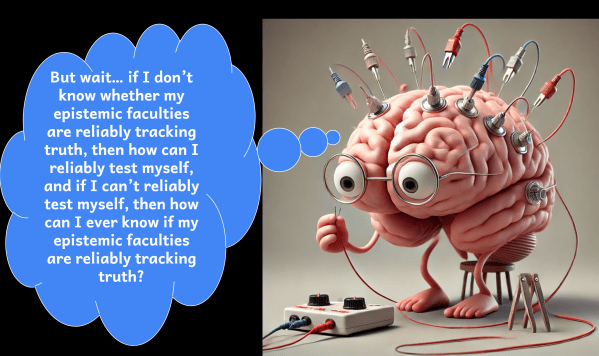
Our Vaisnava philosophy tells us that our senses and reasoning powers are limited and defective when it comes to gaining knowledge. Srila Prabhupada explains:

” … anyone born through the material energy must be subject to the four material deficiencies: bhrama (the tendency to commit mistakes), pramada (the tendency to be illusioned), vipralipsa (the tendency to cheat) and karanapatava (imperfect senses).”

Continue reading “Trusting Our Senses and Cognitive Faculties for Knowledge”

The Foundation of Knowledge in a Vaishnava vs. Atheistic Worldview

By Ajit Krishna Dasa

Epistemology, the study of knowledge, grapples with fundamental questions about how we know what we know and whether our beliefs are justified. Throughout history, various philosophical systems have sought to provide answers to these questions, ranging from rationalism and empiricism to skepticism and postmodern relativism. However, underlying all these systems is a critical debate:

Can human beings build a coherent and reliable epistemology apart from a Supreme Godhead?

Continue reading “The Foundation of Knowledge in a Vaishnava vs. Atheistic Worldview”

Website Powered by WordPress.com.

Up ↑