Can Theists and Atheists Debate Meaningfully? A Vaisnava Perspective

By Ajit Krishna Dasa

The Common Objection: No Shared Foundations

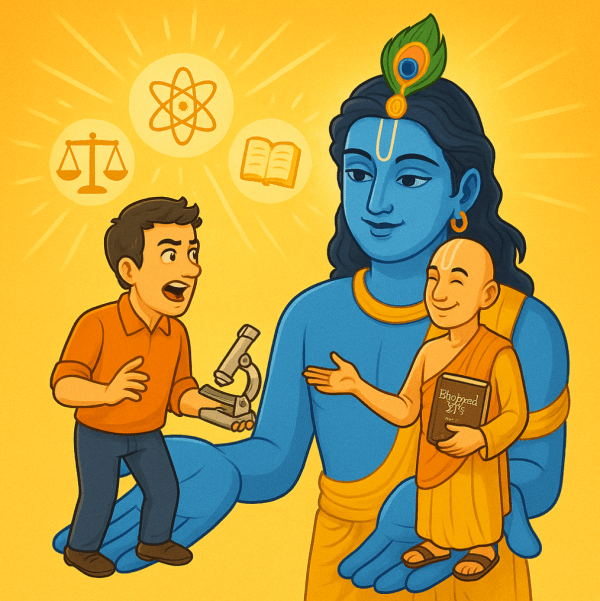
Some argue that meaningful debate between the theist and the atheist is impossible. Their reasoning is simple: if one accepts that reality is founded on the Supreme Person, and the other denies any transcendent source, what real dialogue is possible? Aren’t they just speaking past one another, trapped within incompatible presuppositions?

This objection seems persuasive at first glance. After all, if our basic assumptions about reality, truth, and meaning differ, what common ground could we possibly share?

Continue reading “Can Theists and Atheists Debate Meaningfully? A Vaisnava Perspective”
How Vaisnava Epistemology Grounds an Effective Preaching Method

A Philosophical Framework for Understanding and Preaching Kṛṣṇa Consciousness with Fidelity to Vaiṣṇava Epistemology

By Ajit Krishna Dasa

Introduction: The Pre-experiential Ground of Knowing

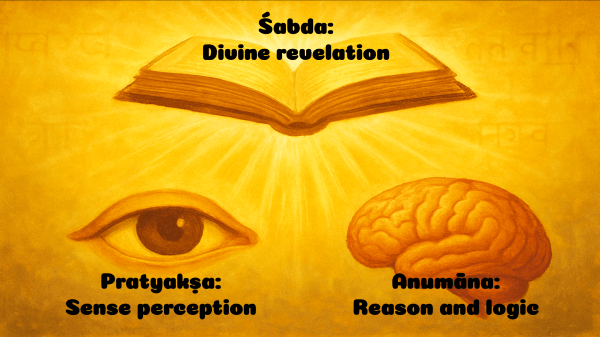
This paper presents a comprehensive framework for understanding Vaiṣṇava epistemology, intended especially for those engaged in the serious intellectual preaching work of Lord Caitanya Mahāprabhu’s mission. We will explore how knowledge begins not with inquiry, but with revelation—how śabda (divine testimony) is not a supplement to reason or perception, but the very ground upon which all rational thought, moral judgment, and empirical investigation rests.

Continue reading “How Vaisnava Epistemology Grounds an Effective Preaching Method”

Who Really Owns Anything? A Vaisnava Critique of Secular Ownership Theories

By Ajit Krishna Dasa

Introduction

Who truly owns anything?

This is not a rhetorical question, nor a speculative indulgence. It is a question as ancient as civilization itself—one that emerges whenever land is claimed, borders are drawn, or wealth is distributed. Beneath every assertion of ‘mine’ lies an ontological mystery: what does it mean to own, and what legitimizes that claim?

Continue reading “Who Really Owns Anything? A Vaisnava Critique of Secular Ownership Theories”

A Vaisnava Response to The Problem of Divine Hiddenness

By Ajit Krishna Dasa

The claim that God is hidden from sincere seekers has become a central objection to theism in contemporary philosophy of religion. The argument suggests that if a perfectly loving God exists, He would ensure that all non-resistant individuals are aware of Him. The absence of such awareness is thus presented as evidence against God’s existence. Yet this objection presupposes a form of spiritual neutrality that the Vaiṣṇava tradition does not accept. According to Vaiṣṇava Vedānta, God is not absent—He is actively resisted. His apparent “hiddenness” is not a flaw in His nature, but a function of His personalism, His respect for the soul’s autonomy, and the moral and ontological conditions necessary for real relationship.

Continue reading “A Vaisnava Response to The Problem of Divine Hiddenness”

Wanting God’s Kingdom Without God

By Ajit Krishna Dasa

Srila Prabhupada, the founder of the International Society for Krishna Consciousness (ISKCON), often pointed out a profound inconsistency in human thinking: “We want the kingdom of God without God.” This statement encapsulates a deep critique of materialistic worldviews, particularly those that seek the benefits of order, purpose, and meaning—attributes traditionally associated with the divine—while rejecting the very source of those qualities. From a Vaisnava perspective, which emphasizes the eternal relationship between the soul and Krishna, the Supreme Personality of Godhead, this contradiction reveals not only a philosophical error but also a spiritual blindness.

Continue reading “Wanting God’s Kingdom Without God”

How Vaisnava Epistemology Defeats Atheism

By Ajit Krishna Dasa

As we engage in philosophical discussions, we must be mindful of our approach. Many devotees of Krishna make the mistake of refuting individual arguments one by one, like facing an attacking lion and trying to wound its limbs instead of stopping it entirely. Imagine being in the wilderness, and a fierce lion suddenly charges toward you. If you panic and merely injure its legs, paws, ears or tail, it will keep coming, adapting to its injuries and growing more aggressive. Every second wasted prolongs the danger. The wise person knows that the only way to truly stop the threat is to aim for the heart or the head—the vital points that ends the attack instantly.

Continue reading “How Vaisnava Epistemology Defeats Atheism”

The Dangers of So-called Neutrality in Preaching

By Ajit Krishna Dasa

The Danger of Adopting an Atheistic Approach

In preaching, I often see devotees of Krishna unknowingly abandon our Vaisnava worldview in favor of an atheistic epistemology. This tends to happen when we engage with atheists or those who rely solely on sense perception and logic—what the Vedic teachings call the aroha-pantha (the ascending path). In such discussions, devotees sometimes concede to the atheistic claim that their aroha-pantha approach is neutral and, therefore, scripture cannot be accepted as proof.

Continue reading “The Dangers of So-called Neutrality in Preaching”

Atheists Observe Life but Fail to Account for It

By Ajit Krishna Dasa

One of the greatest failures of atheistic thought is that while atheists observe life all around them, they are unable to account for its origin in a coherent and consistent way. They assume life must have emerged from matter, yet they cannot demonstrate how or why this would happen. Their worldview fails to provide a foundation for explaining life itself. Materialistic scientists propose that life arises from non-life through random chemical reactions, but this claim remains speculative and unsupported by observable evidence. Srila Prabhupada repeatedly challenged this notion, emphasizing that life comes from life, not from dead matter.

Continue reading “Atheists Observe Life but Fail to Account for It”

Website Powered by WordPress.com.

Up ↑